
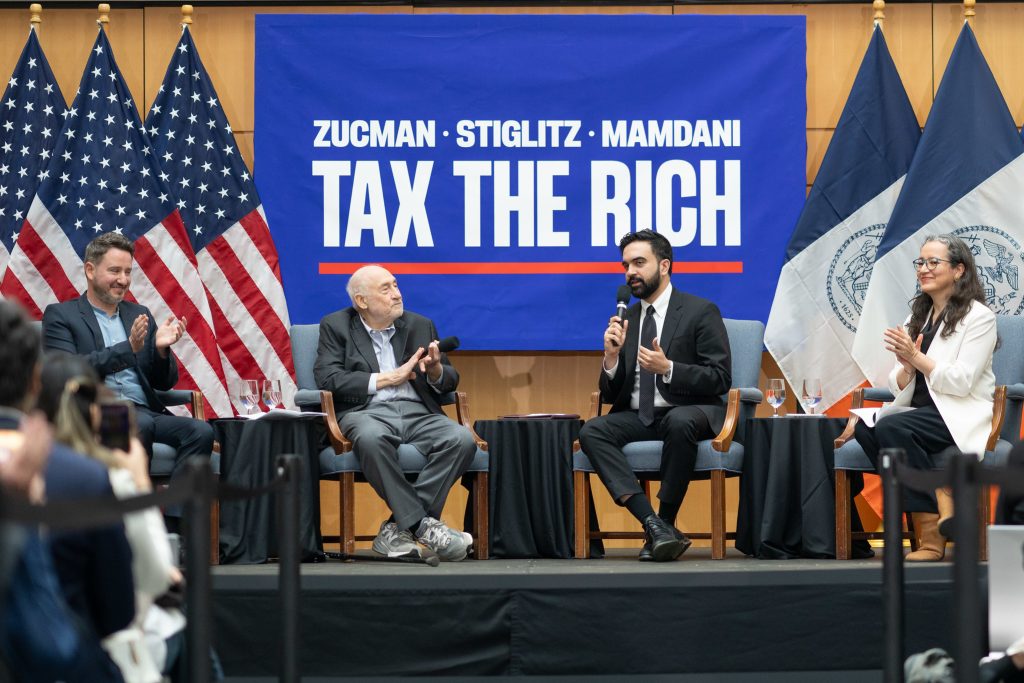
New York City Mayor Zohran Kwame Mamdani holds a Tax Day forum with economists Gabriel Zucman and Joseph Stiglitz.at the CUNY Graduate Center in Manhattan on Wednesday, April 15, 2026. Michael Appleton/Mayoral Photography Office
As the first 100 days of Zohran Mamdani’s administration drew to a close, the mayor gave the city a trial of what he called “pothole politics,” a philosophy of small wins built over time. It is named for the administration’s success in filling potholes across the city at its fastest pace in 11 years. These small but significant wins, like fixing the bike path on the Manhattan Bridge, appear to be microgovernance, but have an outsized impact on what New Yorkers think of the mayor so far. Mamdani said it is just the start of the initiatives he will fully roll out in the coming years.
“For too long, City Hall had not just failed to meet expectations, it had lowered them,” Mamdani said during his 100 Days Address in Queens. “With what we’ve accomplished in fourteen weeks, imagine what we can do in four years.”
In early March he secured a relatively big win. Mamdani and New York State Governor Kathy Hochul announced a $1.2 billion commitment to provide families with free childcare for two-year-olds, fulfilling one of the mayor’s major campaign promises within three months.
The challenge comes from whether or not he can continue to deliver on his promises— potholes and systemic fixes—- while New York City is facing a projected $5.4 billion deficit, which Comptroller Mark Levine called the city’s “biggest budget gap since the Great Recession.”
Mamdani has already signed Executive Order 12 to “strengthen the long-term performance of city government,” that establishes a Chief Savings Officer for each agency tasked with identifying potential cuts to expenses.
The mayor also identified $1.7 billion in savings by cutting back on operational expenses.
How Did We Get Here?
The current deficit is a holdover from the previous administration under former Mayor Eric Adams. “It’s essentially an Adams administration pattern” of underbudgeting, Emily Eisner, Acting Executive Director and Chief Economist of the Fiscal Policy Institute (FPI), said. Several essential services, including housing assistance, required less funding on paper than what they actually cost, leading to spending discrepancies that were underreported. According to CBC NY, in the fiscal year 2023, expenses exceeded revenue by $636 million— one such instance of underbudgeting.
While Mamdani has unveiled much more transparent budget plans, Ana Champeny, Vice President for Research at the Citizens Budget Commission (CBC) told The Polis Project: “the mayor is pushing hard for new taxes” to close the gap Adams left him.
One of Mamdani’s campaign promises was to raise taxes on “the most profitable corporations and the wealthiest New Yorkers.” The proposal also calls for raising income taxes by 2% for New Yorkers making more than $1 million a year, and corporate taxes would rise from their current 7.25% to 11.5%. However, the authority to actually do that lies with the New York State government.
But, as state budget talks plod along in Albany—having already passed its April 1 deadline—the tax hike may not happen. Hochul has repeatedly stated her opposition to Mamdani’s proposal to raise corporate and personal taxes, citing a fear of driving the wealthy out of New York.
Hochul said during a POLITICO summit last month, that while she supports Mamdani’s intentions, she is opposed to implementing the tax itself, saying: “We are in competition with other states who have less of a tax burden on their corporations and their [wealthy] individuals.” Hochul is expected to hold out on her refusal to raise taxes as she campaigns for a second term during this year’s New York gubernatorial elections.
However, the claim that Hochul and others who oppose Mamdani’s tax plan make— that wealthy New Yorkers will simply move away from the city and state— is not totally supported by research. “High earners don’t leave in response to small increases in taxes,” Emily Eisner, Acting Executive Director and Chief Economist of the Fiscal Policy Institute (FPI), told The Polis Project. She pointed towards FPI data that showed that New York State’s highest earners are less likely to move out than working and middle-class residents, and that out-migration did not increase significantly during the tax hikes of 2017 and 2021.
Champeny said that while there would not be a “mass exodus,” millionaires may reconsider continuing to do business in the city.
Outputs Versus Outcomes
Mamdani has proposed a “last resort” plan, should this proposal die in Albany altogether: A 9.5% property tax increase. “I do not want to raise property taxes,” he said during a preliminary budget press conference in February, where he insisted that a tax hike on corporations and high earners is still the best course of action, and acknowledged that a property tax hike would impact middle-class New Yorkers the most. However, Mamdani added, the city is in a fiscal crisis and funds need to come from somewhere.
In a report released by CBC, the worry is that the property tax would actually raise the rent for unregulated housing, or homes without rent control or stabilization.
“There’s nothing that stops the landlords from passing off property tax increases to the tenants when they do renewals,” Champeny said. Additionally, property owners may cut back on operational expenses as the prices of labor and insurance rise, and impact the quality of life for New Yorkers. When utility providers request a rate increase from the state, she added, they often present property tax increases to support their arguments.
Another major component of the housing crisis – a large part of the affordability crisis Mamdani is attempting to address – is the City Fighting Homelessness and Eviction Prevention Supplement (CityFHEPS) rental assistance program. Established in 2018, CityFHEPS is the nation’s second-largest voucher program and the cost has tripled in the last three years. Mamdani received backlash when he appealed a court order to expand CityFHEPS, reneging on his promise to support the program’s expansion during his campaign. While it is important for Mamdani’s affordability agenda and alleviating homelessness, it is, Champeny wrote, on an “unsustainable trajectory.”
“The City cannot voucher its way out of the homelessness crisis,” Champeny wrote in a CBC testimony submitted to New York City Council. She also noted that although more families are receiving vouchers, the amount of households living in shelters has only increased by 21.5%. Campeny suggested a slowdown on large programs like CityFHEPS – capping the amount of CityFHEPS vouchers distributed at its current amount would save $330 million in the 2027 fiscal year.
Champeny and Eisner both suggest that Mamdani tackle New York’s most foundational policy systems, cut out the fat and spend government money more efficiently. “[The city] focuses on outputs rather than outcomes,” Champeny said, “and what you really need to be able to look at is whether or not programs are effective and impactful and achieving the results that you want.”
Hochul and Mamdani made a joint announcement in April that they would implement a pied-à-terre tax—an annual surcharge on homes worth over $5 million whose owners primarily reside outside of New York City. The tax is expected to generate around $500 million in revenue for the city, to be directed towards childcare programs, street cleanliness, and neighborhood safety. “Such investments are necessary to address New York City’s affordability crisis and preserve its economic dynamism,” said a statement released by FPI. However, the statement maintained that Mamdani’s originally-proposed corporate and income taxes are still necessary to close the budget gap.
A Long Road Ahead
With additional pressure coming from federal cuts to services including Medicaid and SNAP, New Yorkers are also facing a lack of access to healthcare and adequate nutrition.
The full impact of the cuts are expected to hit New Yorkers next year, Eisner said, when federal adjustments to services fully set in. By 2027, that includes changes to Medicaid, which would require enrollees to prove they are working or studying in order to keep their coverage, and SNAP, whose proposed changes include work requirements being expanded to include a larger age bracket—and funding being required to partially come from state governments instead of federal.
How hard these cuts will hit New Yorkers is in large part decided by how the state decides to respond in its current budget talks. “I don’t think that the mayoral administration really has the budget to handle that,” Eisner said, “but the state budget does.”
Mamdani is trying to balance a precarious budget “transparently and accurately,” Campeny said, but because his solutions involve establishing new initiatives, which face funding limitations at the state level, many of his promised programs and taxes have “arguably been put on hold or slowed down.”
During his 100 Days Address, Mamdani announced that he would make good on his campaign promise to open one city-owned grocery store in each borough by the end of his term, though the City Council has yet to sign off on his request for funding. He also created the Mayor’s Office of Community Safety, though it is not the large $1.1 billion department he originally proposed during his campaign.“
We’re going to see this agenda roll out over the next few years,” Champeny said, “but having the fiscal challenges and gaps that he does definitely makes it harder.”
In response to Mamdani’s plans, the New York City Council released its own budget proposal without property taxes or reduced funding for essential services. “We cannot in good conscience fund the City’s needs on the backs of homeowners or renters, by digging into emergency reserves, or by cutting essential programs,” Speaker Julie Menin said in a statement.
The City Council suggested closing the budget gap by re-estimating costs, including the wages of city agency roles, to identify areas where money has remained unspent, and construction fees that have yet to be collected can be taken into account. In one suggested alternative, City Council identified $204 million’s worth in savings by re-estimating debt service savings.
Mamdani has called the plan’s expected savings “exaggerating,” saying in a video announcement: “If [Speaker Menin’s] proposal was adopted, it would result in slashing billions of dollars from agency budgets, and working New Yorkers would pay the price” and reaffirming his commitment to taxing the wealthiest in the city.
Mamdani is expected to release his Executive Budget towards the end of this month, which will be reviewed in May by the City Council. However, since the city budget is dependent on state funds as well, New Yorkers will only get a clear picture of how the budget will look as the budget goes through negotiations in the state legislature.
Albany lawmakers passed their fifth spending plan extension – after they could not come to an agreement before the original April 1 deadline – for the proposed $263 billion budget earlier this week.
We like bringing the stories that don’t get told to you. For that, we need your support. However small, we would appreciate it.
This is not a paywall.