
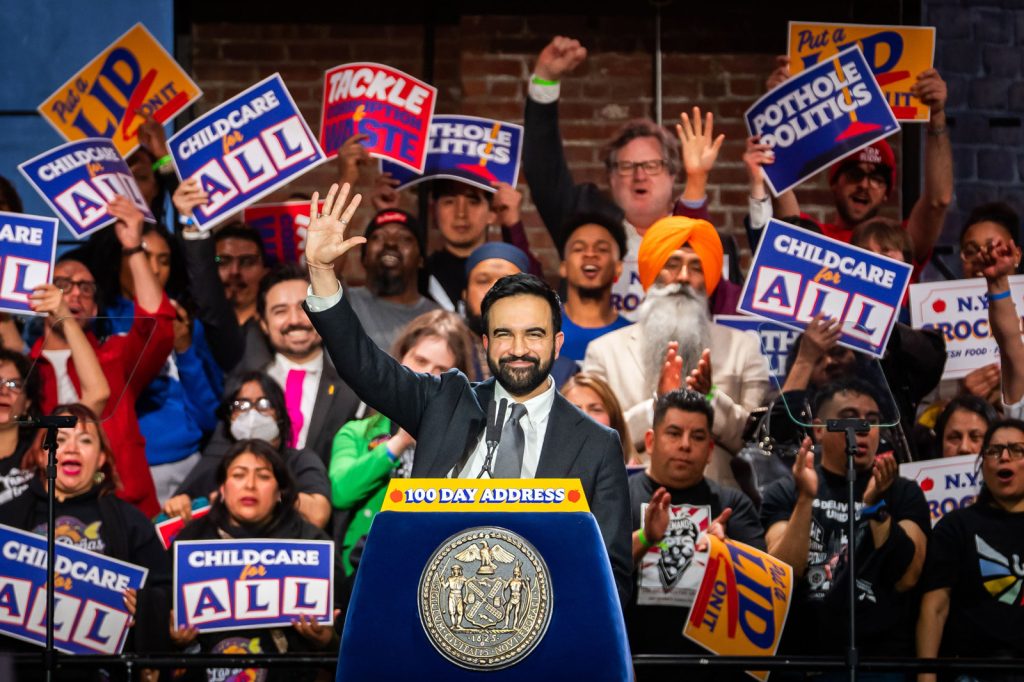
In Maspeths’ Knockdown Center, a gritty venue where indie and local bands typically play, a new type of talent stepped onto the stage — Mayor Zohran Mamdani with promises of a better New York City.
In his first 100 days in office, Mamdani has faced bomb threats, announced a funded plan to implement universal childcare, battled historic back-to-back blizzards, and charmed and disarmed President Trump.
Lex Rountree, a Brooklyn resident who attended Mamdani’s “100 Day Address” on behalf of the New York State Tenant Bloc and Hot Girls Organize, came not only to support the mayor, but also to ensure accountability for his campaign promises.
“It’s the time to celebrate all that we’ve accomplished,” they said. “I’m excited to see where we can go and what we can build from here, especially with [the] rent freeze season coming up.”
As Mamdani recently appointed six of the nine people currently serving on the Rent Guidelines Board, his campaign promise to stop the increase of rent for over a million stabilized units has become within reach, though plans to officially launch the program have not been announced.
Hundreds of attendees came from all over the city to the Queens venue, and were given signs rooting for different causes such as tenants rights, potholes, unions and more. City Hall partnered with the Urban Justice Project for street vendors to sell food, and a City Hall-created, pop-up museum with a collection of items to commemorate Mamdani’s first accomplishments—- a child-sized podium for universal childcare, and a Taco Bell bag and Baja Blast drink in honor of securing labor rights for delivery workers, to name a few—- were on display. A DJ played Bad Bunny to hype the crowd up in anticipation for the man of the hour, along with brief speeches given by local advocates for transportation, tenants rights, and childcare.
In his speech, Mamdani recounted some of the accomplishments achieved since his inauguration – $34 million in settlements, judgements, and repairs for tenants; record low murder rates; and expansion of labor rights for nurses and delivery workers. He made bold proclamations of his identity as a Democratic Socialist, fighting for immigrants targeted by ICE, and standing beside anyone in the city who is “under attack from the federal government’s cruelty or suffocating under the affordability crisis.”
“For too long, City Hall had not just failed to meet expectations, it had lowered them… After years of broken promises, no one could be blamed for doubting that government held either the ability or the ambition to upend the status quo. Yet as I said on that freezing January afternoon to more than 8.5 million New Yorkers: ‘We will make no apology for what we believe. I was elected as a Democratic socialist and I will govern as a Democratic socialist.’ For 102 days, we have done just that.”
He went on to make announcements for City Hall’s plans for the remainder of his term. City-run grocery stores were at the top of the list.
Across the city, nearly 1.8 million residents receive SNAP benefits. The affordability crisis has hit home for those residents—- and millions more who earn too much income to qualify for assistance, but not enough to afford inflated food costs. Grocery stores— subsidized and managed by the city—- are one method the Mamdani administration wants to employ to address the issue.
The stores, which are estimated to cost the city around $60 million to subsidize, would buy and sell groceries at wholesale prices to make the products cheaper for purchase. For example, staples like eggs and milk may be up to 25% cheaper than at regular grocery stores, operating with a minimal overhead surcharge much like military base commissaries that offer discounted goods. Exact prices have not been announced as yet since these will be determined by a variety of market factors, including federal budget cuts and tariffs. But, also, prices across the city vary widely depending on the neighborhood. In East Harlem, where La Marqueta is located, the price of a dozen eggs at grocery store Aldi was under $2 and a gallon of milk was around $1.55, per reporting and price tracking by Gothamist.
Mamdani has previously said the money would come from existing city funding that subsidizes private grocery store owners, along with a corporate tax increase and individual tax increase for those earning $1 million or more.
The first one is expected to open next year in East Harlem at La Marqueta, which is one of several public markets already operating in the city. Opened by former Mayor Fiorello LaGuardia in 1963, it is a marketplace for local vendors as well as a community event space— and an area where residents have more recently complained of a lack of options for affordable and healthy groceries.
“Stores where prices are fair, where workers are treated with dignity, and where New Yorkers can actually afford to shop,” he said. “At our stores, eggs will be cheaper. Bread will be cheaper. Grocery shopping will no longer be an unsolvable equation.”
The administration has a goal of opening a city-run store in each borough by the end of his term.
“Some will insist that city-owned businesses do not work, that government cannot keep up with corporations,” he said. “My answer to them is simple: I look forward to the competition. May the most affordable grocery store win.”
Mamdani then referenced Senator Bernie Sanders, and how his leadership inspires him to make such changes—- when the Vermont lawmaker suddenly stepped on stage with him.
“We’ve got a crisis, an epidemic in diabetes,” Sanders said. “So, when we talk about making decent quality food affordable to all people, it’s not only the right thing to do, in the end of the day, it’s going to save money. Making sure our kids eat healthy food is not a radical idea, it’s what every government should be doing.”
Mamdani went on to also announce an “ambitious” campaign for trash containerization across the city for every residential property by the end of 2031, and at least one fully containerized district in every borough by the end of next year. Initial phases of this project were started by Mayor Eric Adams in communities like Harlem, however, it was never expanded. Now, Mamdani says the trash bins will finally come to other boroughs, and the nearly 44 million pounds of trash produced each day will be in containers.
“So, New York City, say goodbye to black bags, say hello to the bins,” he said. “Sidewalks will be clean. Rats will go hungry. Trash won’t know what hit it.”
Mamdani addressed another campaign promise: a more efficient commute for New Yorkers. Mamdani is aiming to shave off six minutes from the average commute, focusing on outer-borough residents who live more than half a mile away from the train or bus, with a newly designed route and faster buses in partnership with Governor Kathy Hochul, the state Department of Transportation, and the Metropolitan Transportation Authority.
“When we talk about who rides the bus, we are talking about New Yorkers who have too often been overlooked in our politics — disproportionately working class, Black, brown, outer-borough riders, the very New Yorkers who have been told to make do, riding the slowest buses in America,” he said. “No longer.”
He closed his speech with the promise that the best days of the administration were ahead.
“The work is there to be done,” he said. “Together, let’s go after it and get it.”
For spectators, Mamdanis’ speech brings a promising tomorrow not just for the city, but what could shape the rest of the country.
“It’s really nice to see someone just bring new ideas to the table,” said Yahaya Sanchez, a Brooklyn resident who’s a first-generation New Yorker. “We’re a city that moves forward, we make the markers…[so I’m] definitely excited about those changes, especially [at the] city level just improving the lives of working families.”
We like bringing the stories that don’t get told to you. For that, we need your support. However small, we would appreciate it.
This is not a paywall.