
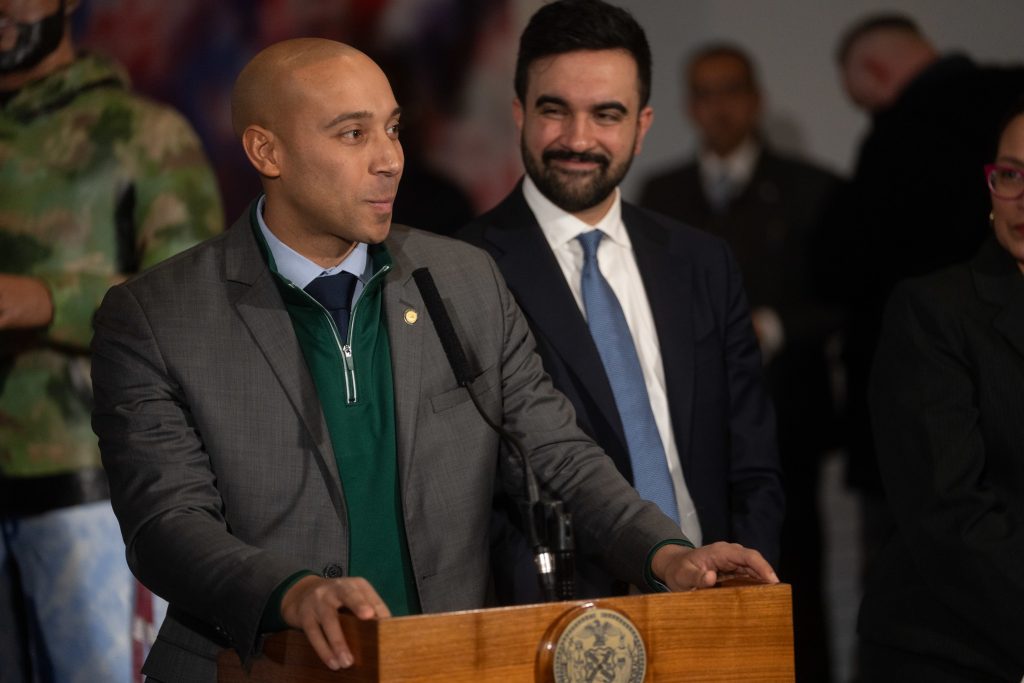
Mayor Zohran Mamdani announces five new appointments including, Dr. Alister Martin as Commissioner of the New York City Department of Health and Mental Hygiene/ Saturday, January 31, 2026. Michael Appleton/Mayoral Photography Office
Zohran Mamdani’s pick for Commissioner of Health, Dr. Alister Martin, comes at a crucial time: Not only is New York City bracing for federal cuts, but the skyrocketing price tag on living in the city—whether rent or groceries—has put a strain on NYC’s public health.
In an open letter to Mamdani from Columbia University’s Heilbrunn Department of Population and Family Health, Professor Thoại D. Ngô said that by delivering on his affordability agenda, Mamdani would be building a framework for improving the health and wellbeing of New Yorkers. The letter, titled “Six Public Health Priorities for New York City,” urges, first and foremost, that Mamdani “treat housing and cost of living as core public health policy.”
This seems to be in alignment with the goals of the newly-appointed Martin, who said his biggest challenge as Commissioner of Health would be “keeping New Yorkers safe and healthy in the face of having to think about the threats that are coming from Washington, D.C.,” in an interview with MedPage Today. “We as a public health department can help connect people to that funding to address the financial instability in their lives,” Martin said. “We’re going to help our agency partners throughout the city do that work through the lens of healthcare.”
“Housing policy is health policy,” Ngô wrote in the open letter. In a separate op-ed piece for Newsweek, he pointed towards Hurricane Ida in 2021—when families drowned in flooded basement apartments—as an example where lack of affordable housing, economic assistance and climate change-resistant stormwater infrastructure took people’s lives. All three assets are included in the open letter’s six points. “Affordability cannot deliver dignity or mobility if the structural conditions shaping people’s lives remain unchanged,” Ngô argued in the op-ed.
While Mamdani has been moving forward on his campaign promises that would confront these points, many have been stalled. He announced at his 100 Days’ Address that the first of his city-owned grocery stores would be opened in 2027. Meanwhile, his promised Department of Community Safety, meant to respond to mental health crises with social workers instead of the police, was opened as an office with a much smaller budget.
The Chilling Effect
According to the Coalition for Asian American Children and Families (CACF), a nonprofit advocacy group based in the city, Martin’s challenge is the “chilling effect” that is sweeping through the city’s immigrant communities. In a recent report, CACF said AAPI immigrants in the city are not only fearful of detainment by Immigration and Customs Enforcement (ICE) and anxious about federal cuts to services like Medicaid subsidies and SNAP food assistance, but are also refusing to seek out medical and food help altogether.
Because immigrant New Yorkers don’t want to become a “public charge,” seen as a liability, many non-citizens are further motivated to eschew assistance. “That’s the actual legal terminology that they use,” CACF Co-Executive Director Anita Gundanna told The Polis Project, “but it isn’t necessarily the most human way of talking about people and their needs.”
For decades, the United States Department of Homeland Security has defined a “public charge” as an immigrant who is or may become primarily dependent on government assistance for the long term. It is a “test that the federal government imposes on people who are looking for visas or green cards,” Gundanna said. Fail the test, and it could block a person’s path to citizenship or even spell deportation.
“Overall, many immigrants are forced to deprioritize their health to prioritize other essential needs (i.e.: housing and food) and above all, their safety,” the CACF report said.
Much of the hesitation comes from the fear and uncertainty that immigrant communities face. Accessing healthcare has, time and again, proven difficult even before the announcement of incoming cuts.
CACF has a network of patient navigators who help New York residents submit applications to the New York State Department of Health, and overcome access issues.
One such obstacle is language support for New Yorkers with limited English proficiency. “Language access has been a problem for many, many years,” Gundanna said. While there may be language support during some stages of seeking services, it is not guaranteed for the entire process of their treatment. “They may receive support during their care, but what about their billing process?”
ICE presence also has immigrant families on edge, Gundanna said, which contributes to the chilling effect. “People don’t want to, for example, stand in lines for food pantries, for fear that they would be targeted at those lines,” she said. “It’s not just healthcare. It’s also food, housing, other things where folks are not attached to the social safety nets that they need.”
In the past, “government assistance” has not meant basic social safety nets like healthcare and health benefits, but “public cash assistance or long-term institutionalization at government expense,” including federal programs like Social Security Income and Temporary Assistance for Needy Families. Since November of last year, however, the Trump administration may expand the definition of government assistance to include Medicaid and SNAP.
As experts pointed out, however, undocumented immigrants are already barred from healthcare benefits. Nothing has changed except more immigrants, regardless of status, are no longer seeking basic care.
In New York, Reham Bader, Director of Community Health & Well-Being at the Arab-American Family Support Center of New York (AAFSC), said, “I can’t even tell you how many times clients have had their benefits completely stolen with no solution, no chance to replenish them.” New York State Governor Kathy Hochul announced a proposal earlier this year to put chips in EBT cards, to prevent mass skimming, but due to lack of funding, many benefits still may be rolled back.
Separate from the federal cuts to Medicaid and SNAP, Hochul plans to shrink the Essential Plan, a 2015 government-financed health coverage for New Yorkers who make marginally more money than the income qualifications for Medicaid. In New York City, 233,000 residents are expected to lose coverage by July.
CBOs
The difficulties of navigating these services are nothing new, as Maha Attieh, Health Program Manager at AAFSC, pointed out. For the last 23 years, she has been working in the health system, and in that time, she has observed consistent issues.
Cultural norms differ across communities. Attieh has observed a sense of shame in accepting help amongst Arab communities. “‘Are you gonna get my name?’” she recalled people asking. “‘Are you gonna tell anyone?’ ‘I can pick up this food?’ I said, ‘Nobody will know. We will never reveal your name.’”
But as the CACF pointed out, there is an existing infrastructure to help immigrant communities access services and accurate public health information: Community-based organizations, or CBOs.
“Underlying what all we’re talking about is the trust that community organizations have,” Gundanna said. CBOs host in-person events and work directly with community members. In AAFSC’s case, it held a Ramadan Nutrition Workshop for Muslim Arabs who were fasting.
Before he entered politics, Mamdani himself worked as a foreclosure prevention housing counselor for Chhaya Community Development Corporation, a social services organization for South Asian and Indo-Caribbean communities based in Queens. Chhaya’s program director at the time, Will Spisak, said in an interview with The New York Times that Mamdani’s ability to speak Bangla, Hindi and Urdu convinced him to hire him.
Mamdani ran for his former seat as a Queens assemblymember during his time at Chhaya. Some of his skills and priorities are still evident in his role as mayor. During his campaign, he released a series of social media videos in which he speaks the aforementioned languages in order to reach a wider audience.
And his work at Chhaya helping immigrant families that faced housing insecurity is echoed in his recent moves as mayor, which includes his announcement of the “Neighborhood Builders Fast Track” to build more affordable housing and proposal to halt annual increases for rent-stabilized units throughout the city.
Mamdani has signaled that he is aware of the pivotal role of CBOs in accessing programs, including public health services. One of Mamdani’s first executive orders established the Mayor’s Office of Mass Engagement (OME), which is meant to establish a direct line of communication between the city government and the city’s communities.
As of April, Gundanna is trying to collaborate with the OME. “We’re hopeful to be stronger partners with this administration to really ensure that community voices are heard,” she said.
In the meantime, “legal stress, family separation and trauma are driving crisis-level mental health symptoms across immigrant communities,” the CACF report stated, leading CBOs like the South Asian Council for Social Services and Sapna NYC to promote community-rooted approaches that not only connect immigrants to legal and healthcare resources, but provide a space to engage in advocacy for immigrant rights.
“If you’re not advocating for your own community, nobody’s going to listen,” Attieh said.
We like bringing the stories that don’t get told to you. For that, we need your support. However small, we would appreciate it.
This is not a paywall.