
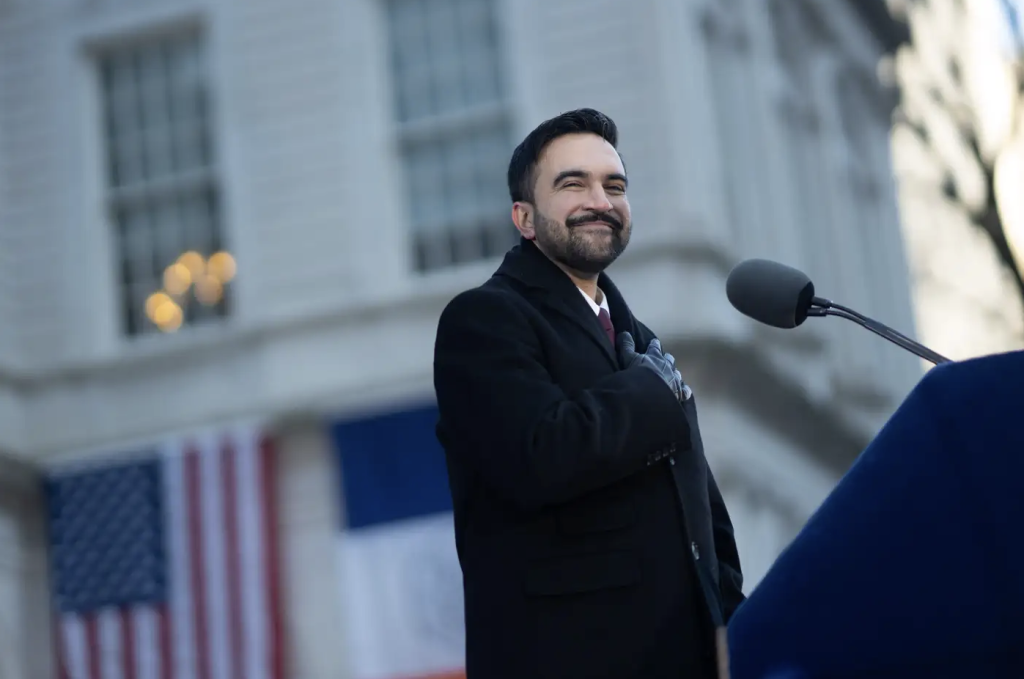
Michael Appleton/Mayoral Photography Office
At the stroke of midnight on January 1, 2026, Zohran Kwame Mamdani was sworn in as New York City mayor – the first South Asian, Muslim, and Democratic Socialist party member to be elected to the position. He becomes the city’s 112th mayor and is one of the youngest people to ever helm the city government, at just 34 years old. From an intimate event with just a few dozen family, friends, and officials in City Hall’s abandoned subway station to free and public block parties at both City Hall in Manhattan and his former State Assembly district, Astoria, Queens, Mamdani took office breaking traditions, just like his campaign.
New York Attorney General Letitia James read the oath of office while Mamdani’s wife Rama Duwaji held a Quran once owned by Arturo Schomburg, an Afro-Puerto Rican historian and namesake for the the New York Public Library’s Schomburg Center for Research in Black Culture. The ceremony was an intimate one with just two dozen or so family, friends, and officials on hand.
Being sworn in by taking the 6 train down to a decommissioned station under City Hall was a nod to the city’s subway system being an ‘equalizer’ for all New Yorkers, as James said. The new mayor also took the opportunity to name a new Transportation Commissioner, Michael Flynn, a longtime transit official. The move was a significant one, signalling a priority to make one of his core affordability policies— to make city buses free— a reality. However, neither Flynn nor the city have sole control over that. To improve the subway system New Yorkers have complained about for years because of crumbling infrastructure and flooding, Mamdani and now Flynn, will have to work with New York Governor Kathy Hochul.
With thousands lining the streets in the freezing cold weather, some driving in from as far as Wisconsin, the city has never seen an inauguration like this for such an electric—and polarizing—national figure.
The public ceremony on the steps of City Hall served as a rallying cry for the city’s progressive movement, bringing together a coalition that included Representative Alexandria Ocasio Cortez, who opened the ceremony with a line meant to set the tone: “It is the people of New York City who have chosen historic, ambitious leadership in response to untenable and unprecedented times. We have chosen…prosperity for the many rather than spoils for the few.”
Public Advocate Jumaane Williams and Comptroller Mark Levine, who were also sworn in, were among the speakers as well. Williams spoke of the “contradictions” of the city, choosing hope over fear, while Levine promised to use the Comptroller’s office to further Mamdani’s ambitious affordability-first agenda, saying: “Our city today is booming for people at the top, but it’s getting tougher and tougher for working families to pay their rent to find a job with a living wage, and yes, Mr. Mayor, to find affordable childcare.”
However, the energy peaked with the introduction of Senator Bernie Sanders, who administered the ceremonial oath to Mamdani. Sanders, a long-time ally who represents Vermont in the U.S. Senate but is originally from Brooklyn, delivered a fiery rebuke of the economic status quo that Mamdani campaigned against. “The top 1% have never, ever had it so good,” Sanders told the cheering crowd, emphasizing the disparity in the nation’s wealth. “And yet there are billionaires and large corporations that pay almost nothing in taxes. That has got to end.” Sanders framed the incoming mayor’s agenda—which critics have labeled “radical”—as common-sense necessities, arguing that affordable housing and universal childcare are simply “the right and decent thing to do.”
In his inaugural address, Mayor Mamdani neither pivoted to the center, nor narrowed the scope of his campaign promises. Instead, he doubled down on the platform that resulted in his historic upset of the political establishment in the city and state. “I was elected as a Democratic socialist, and I will govern as a Democratic socialist,” Mamdani declared. He sketched a vision of a “tale of eight and a half million cities,” moving beyond the old “tale of two cities” narrative to embrace the complex, woven lives of every New Yorker—from “Russian Jewish immigrants in Brighton Beach” to “Black homeowners in St. Albans” to the “Pakistani auntie named Samina” he spoke with during his open office hours prior to being sworn in.
Mamdani also delivered a sharp critique of how civility has been weaponized against the working class. “For too long, those fluent in the good grammar of civility have deployed decorum to mask agendas of cruelty,” he said, signaling an administration that would prioritize “audacious” action over polite stagnation. He promised to freeze rents for stabilized homes and make buses “fast and free,” asserting that “freedom has belonged only to those who can afford to buy it,” and that his administration would change that.
Inauguration speeches are just that, ceremonial and meant to keep the momentum of campaign victories going forward and a reminder that governing is a different beast than electoral politics. As the ceremony concluded, Mamdani acknowledged the “daunting reality” of the work ahead, from the mental health crisis to crumbling infrastructure. Calling on New Yorkers to stay engaged beyond Election Day, he ended with a sober reminder that the victory was just the beginning. “The work continues, the work endures,” he said. “The work, my friends, has only just begun.”
We like bringing the stories that don’t get told to you. For that, we need your support. However small, we would appreciate it.
This is not a paywall.