
On January 26, 2026, NYPD officers shot 22-year-old Bangladeshi New Yorker Jabez Chakraborty five times inside his Queens home during an emotional distress call—his family had dialed 911 for an ambulance, not the police. The NYPD claims Chakraborty grabbed a large kitchen knife, ignored commands to drop the weapon, and posed an immediate threat.
But in a January 30 statement, the group Desis Rising Up & Moving (DRUM) and the family denounced the “brutal and unjustified” shooting as a betrayal inside their own home, where no such threat existed. They reported that officers subjected them to hours of precinct interrogation, coerced phone seizures without cause, questioning about immigration status, and over 24 hours of hospital access denial while Jabez remained under NYPD guard.
The Queens District Attorney later charged the critically injured and ventilator-bound Jabez with attempted murder.
Tweet from x.com
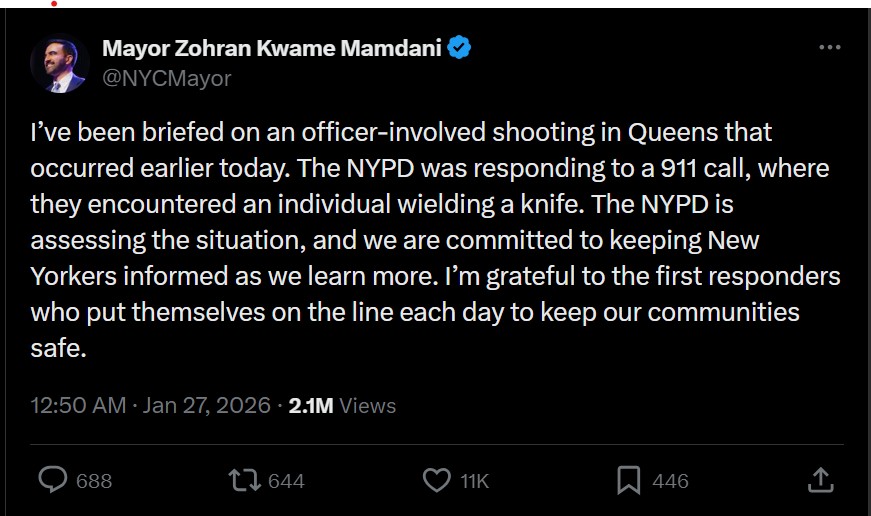
Mayor Zohran Mamdani swiftly characterized the incident as “officer-involved shooting” and praised the officers as “first responders who put themselves on the line.” The family condemned Mayor Mamdani’s statement, questioning, “Why is the Mayor applauding officers who recklessly almost killed our son in front of us?”
In Chakraborty’s case, a 911 call sent armed officers to what should have been a mental health check. Yet, predictive policing flagged “distress” as a “threat” in immigrant spaces, escalating to multiple shots being fired at Chakraborty. This was inevitable given New York City’s decades-long racialized surveillance system and its policing policy that routes wellness checks to armed police rather than mental health support.
Take another example. In East New York, Brooklyn’s most surveilled neighborhood, where 54% of residents are Black and 30% Latino, over 577 surveillance cameras blanket intersections once synonymous with stop-and-frisk hotspots, according to Amnesty International’s data. A 2020 facial recognition glitch misidentified a Black Lives Matter protester from an Instagram photo, dispatching riot gear, helicopters, and dogs to his door for hours.
This is the racialized reality of NYPD’s surveillance machine, turbocharged by private foundation donations and global branding, in addition to its whopping $6 billion a year of city funds–about 10 times more than what the city allocates to its public libraries–under Commissioner Jessica Tisch
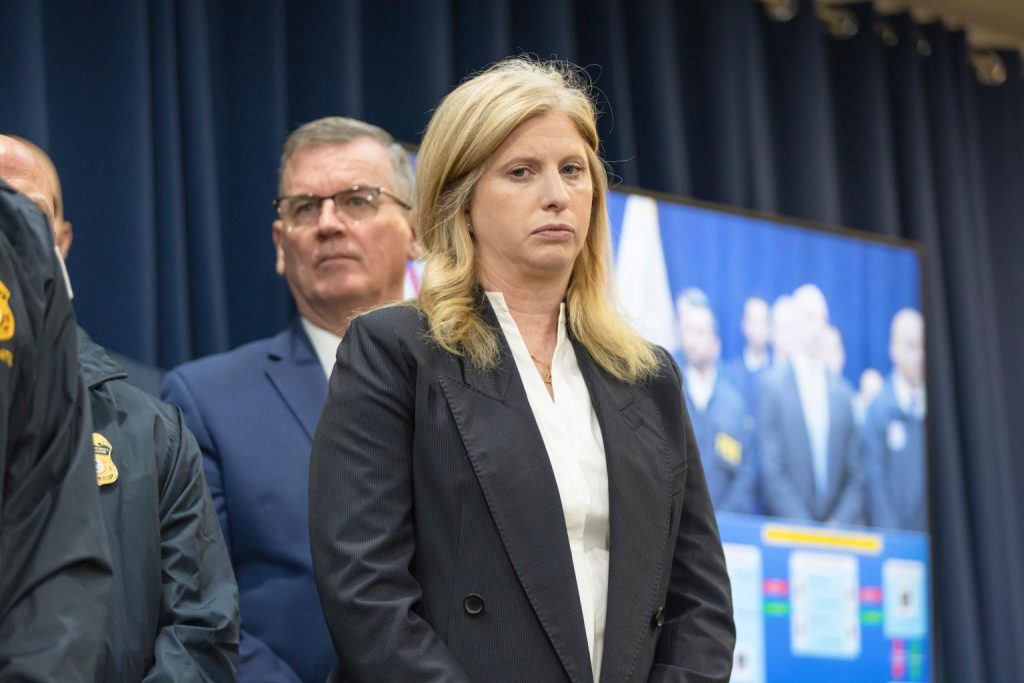
Jessica Tisch assumed the role of NYPD Commissioner in late 2024 under then-Mayor Eric Adams. She was retained as Commissioner through 2026 under the newly elected progressive mayor, Zohran Mamdani. Mamdani faced sharp backlash from grassroots organizations, public defenders, and police accountability advocates for this decision, with critics framing it as a betrayal of his campaign pledges to demilitarize policing, abolish the Criminal Group Database (often called gang database) and counterterrorist Strategic Response Group (SRG) units, and prioritize community safety over surveillance and repression.
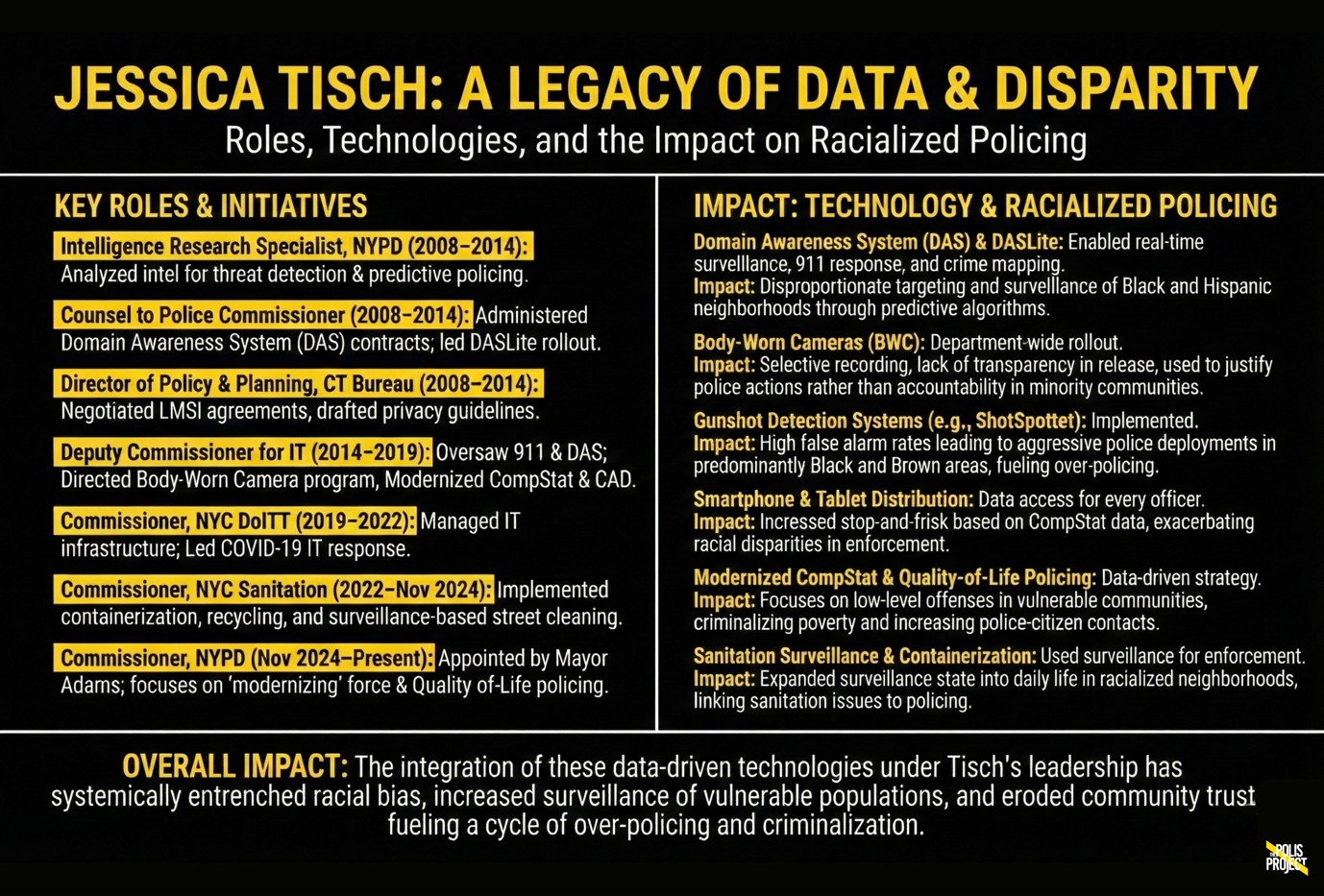
Commissioner Jessica Tisch’s career trajectory neatly overlays New York City’s pivot toward intensified surveillance and the steady militarization of the NYPD. Joining the force in 2008, she advanced through pivotal civilian roles in counterterrorism and information technology—overseeing the Domain Awareness System, body-worn cameras, and data-driven tools—before ascending to commissioner in 2024, all while embodying the city’s fusion of billionaire capital, technocratic governance, and carceral power sustained by elite donors and foundations.
Tisch’s tenure also coincides with the re-entrenchment of “broken windows” policing tactics—namely, prioritizing low-level arrests for minor infractions—which critics have long linked to racialized policing that disproportionately targeted Black and Latino communities. While the policy was never formally ended, it has returned under Tisch through renewed “quality-of-life” enforcement policing, subway deployments, and a focus on misdemeanors, despite progressive pushback.
To understand how the fault lines between Mamdani and Tisch might become apparent in the next few months, it is necessary to take a deep dive into Commissioner Tisch’s family background, her work since 2008, the intricate policing system she has helped build and defend, and what that has meant for working and communities of color in New York City.
The Tisch family is among the top 50 richest families in the U.S., and wields immense influence in New York City politics through campaign gifts and political action committees (PACs). Loews Corporation, controlled by the family for more than six decades, has evolved from a movie theater chain into a diversified conglomerate owning major stakes in commercial real estate, property and casualty insurance, natural gas pipelines, Loews Hotels, and packaging. It generated $17.5 billion in revenue and $1.4 billion in net income in 2024 alone, steadily building the family’s $10.1 billion fortune.
Members of the Tisch family have donated $117,000 across the 2021 mayoral races, including more than $10,000 to Eric Adams and his allies. Commissioner Tisch’s father, James Tisch—CEO of Loews Corporation and the son of co-founder Laurence Tisch—donated $2,000 to Adams’ campaign. His wife and Jessica Tisch’s mother, Merryl Tisch—former New York State Board of Regents Chancellor—matched that amount with $2,000.
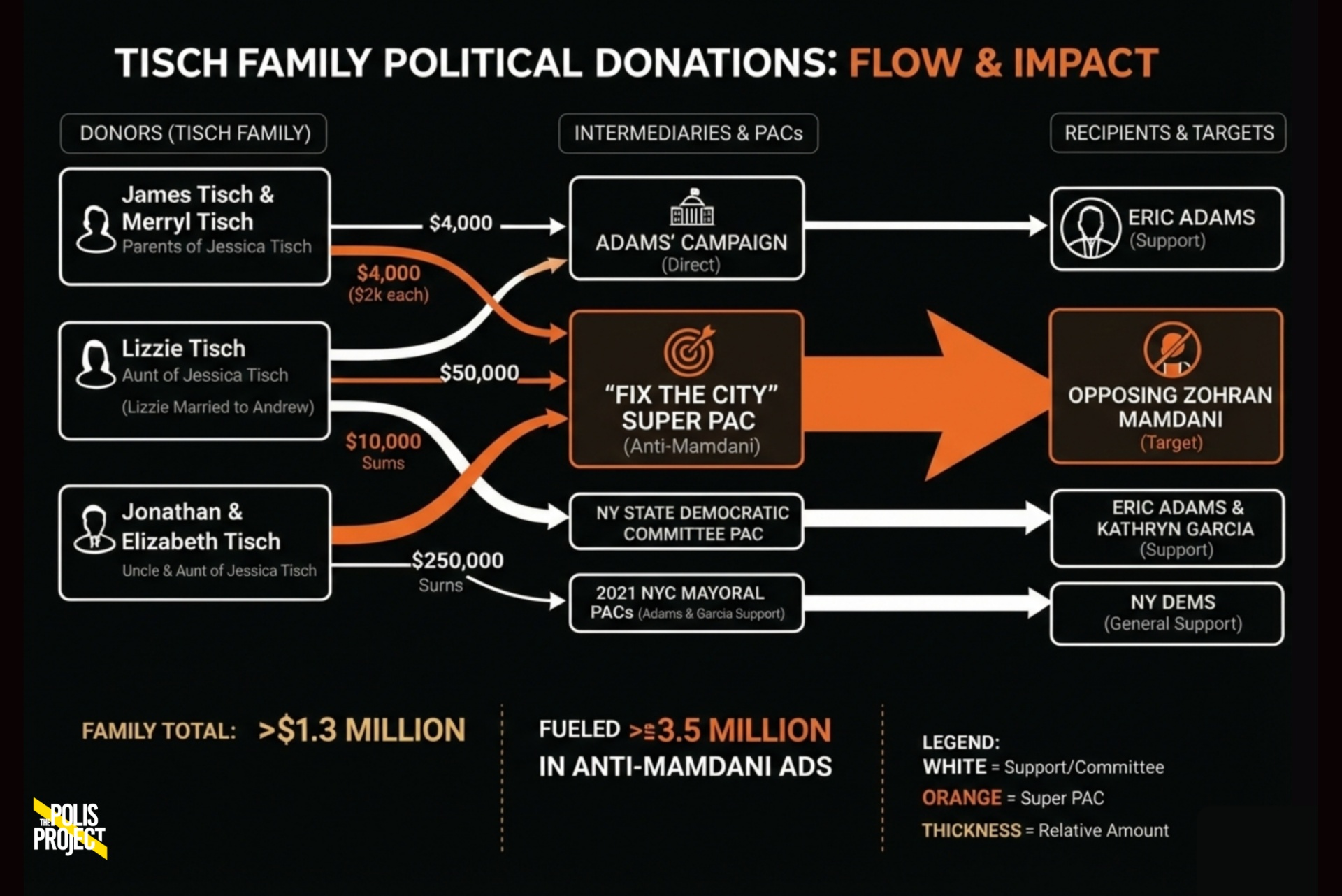
Lizzie Tisch, James’s sister-in-law (married to his brother Andrew) and thus Jessica’s aunt, contributed more than $50,000 to Democratic establishment PACs opposing progressives—including $50,000 to the anti-Mamdani “Fix the City” super PAC in the 2025 NYC mayoral race, $10,000 to the New York State Democratic Committee PAC in 2022, and sums to 2021 NYC mayoral PACs supporting Eric Adams and Kathryn Garcia. Jonathan and Elizabeth Tisch, Jessica Tisch’s uncle and aunt, also donated $250,000 to Fix the City, as part of a family total exceeding $1.3 million that fueled more than $35 million in ads against Mamdani’s campaign’s success. In fact, super PAC money outspent Mamdani 20 to 1, despite the city’s matching funds system.
Tisch family members also donate to the New York City Police Foundation (NYCPF), a multimillion-dollar nonprofit founded in the 1970s. It is chaired by Andrew Tisch—the Commissioner’s uncle—though public records do not specify the frequency or dollar amounts of these contributions beyond Loews Corporation’s significant COVID-era in-kind support.
Unlike the taxpayer-funded $6 billion NYPD budget—which requires line-item approval, hearings, and votes—donations to the New York City Police Foundation (NYCPF) are treated as nonprofit “gifts,” with no bidding process or veto power. This has led to the foundation’s grants being referred to as “slush funds” by critics such as the Surveillance Technology Oversight Project (STOP), the Legal Aid Society, and the NYCLU, because they operate as pots of private money that evade typical budget scrutiny. These private “slush funds” total over $159 million from 2007 to 2021, and have bypassed City Council oversight through a loophole in private philanthropy. In the last three years, the foundation has generated a cumulative revenue of more than $30 million.
These slush funds have enabled secretive, untraceable purchases of controversial surveillance gear without public reporting, accountability, or elected official input. The Domain Awareness System (DAS)—the world’s largest municipal digital surveillance network with over 30,000 cameras and billions of integrated data points from CCTV, license plate readers, radiation sensors, 911 calls, and arrest records—exemplifies this opaque expansion.
Alongside this, the NYCPF piloted experimental tech, such as body cameras (54 Taser/VieVu units in 2015) and license plate readers, which were donated by Palantir and Motorola. These corporations later won city contracts, creating oversight “blind spots” that critics say benefit undisclosed donors, while funding CompStat—the pioneering crime-mapping and precinct accountability system—and precinct grants for biometrics and stingrays.
“For years, the NYPD has hidden its surveillance slush fund from the public, not to protect us, but to protect its bottom line,” STOP executive director Albert Fox Cahn argued. “These technologies are expensive, invasive, and just don’t work. But the NYPD isn’t just wasting millions on unproven technologies; it’s putting Black and Brown communities at risk. High-tech errors are often just the first step to false arrest, wrongful imprisonment, and being torn away from your family because of a faulty algorithm.”
In the year after 9/11, policing in NYC was fundamentally recast as a revenue-generating asset class that securitized both domestic streets and global markets. In this model, vendors acquired NYPD as a marquee client, leveraging its “brand” for worldwide pitches. In return, the NYPD gains “free” upgrades, such as predictive policing drawn from DAS data, echoing the original model’s evasion of public oversight.
The Domain Awareness System, for example, pioneered a privatized international model: New York City fronted $40 million (in NYPD funds plus federal grants), enabling Microsoft to market customized DAS software globally to agencies like DC Metro PD, Brazilian and Singaporean police, security for the 2016 Summer Olympics, and the 2014 FIFA World Cup. In return, the city received 30% of gross revenue from these exports, generating undisclosed income. In all, there were over $600 million in total investments over about seven years, all while enabling biometric and AI upgrades without new public funding.
“Public safety” thus started to look like an economy in its own right, an apparatus that generated profit. As Police Commissioner under Eric Adams, Tisch replicated this blueprint, piloting 2025 AI video analytics, CompStat 2.0 pattern recognition, and high-risk flagging tools for the NYPD via private vendors and the New York City Police Foundation streams, once again bypassing transparent budgeting for corporate co-development.
Commissioner Tisch’s own career at the NYPD has coincided with the expansion of New York City’s surveillance infrastructure. Tisch joined the NYPD in 2008 as a counterterrorism analyst under Commissioner Ray Kelly, in a post-9/11 era that increasingly relied on intelligence integration and data analytics to enable predictive policing, pattern detection in crime trends, and real-time suspect tracking across vast datasets.
In 2014, Tisch was appointed Deputy Commissioner for Information Technology, placing her at the helm of the NYPD’s digital transformation and data systems. One of her major undertakings was the $161 million NYPD Mobility Initiative, announced in October 2014 by Mayor Bill de Blasio. The program equipped more than 35,000 officers with Microsoft smartphones (Windows Phone) and 6,000 patrol cars with rugged tablets, providing real-time access to 911 calls, the DAS, and department databases, deepening the disciplinary gaze.
The NYPD’s DAS, developed in partnership with Microsoft and Palantir, serves as the central nervous system of the police force’s surveillance apparatus. Launched in Lower Manhattan in 2008 and expanded citywide by 2012, DAS aggregates data from real-time feeds from around 30,000 CCTV cameras, radiation monitors, 54 million 911 calls analyzed for risk patterns, alongside legacy databases of two million warrants, 15 million complaints, and 100 million summonses.
By linking DAS with mobile devices, CompStat 2.0 dashboards (a data-management system), and body-worn cameras during Tisch’s tenure as Deputy Commissioner of Information Technology, the NYPD advanced a predictive policing model where DAS feeds real-time sensor data—CCTV, license plate readers, 911 calls—directly into CompStat 2.0’s interactive crime maps and officer apps for pattern detection, geospatial analysis, and individualized risk flagging.
Perpetuating Cycles of Profiling and Containment in Communities of Color.
DAS has disproportionately targeted communities of color through higher camera concentrations in Black/Latino neighborhoods—like East New York in Brooklyn (54% Black, 30% Hispanic), the most surveilled area. There are 577 DAS-compatible cameras at intersections in East New York, far exceeding whiter areas, and they have correlated directly with historical stop-and-frisk hotspots. Amnesty International’s mapping of over 15,000 NYPD-accessible cameras across Manhattan, Brooklyn, and the Bronx confirms denser surveillance in majority non-white communities, amplifying “digital stop-and-frisk” in the Bronx, Brooklyn, and Queens. This occurs alongside routine surveillance of mosques, Black Lives Matter rallies, and immigrant areas via license plate readers logging billions of scans.
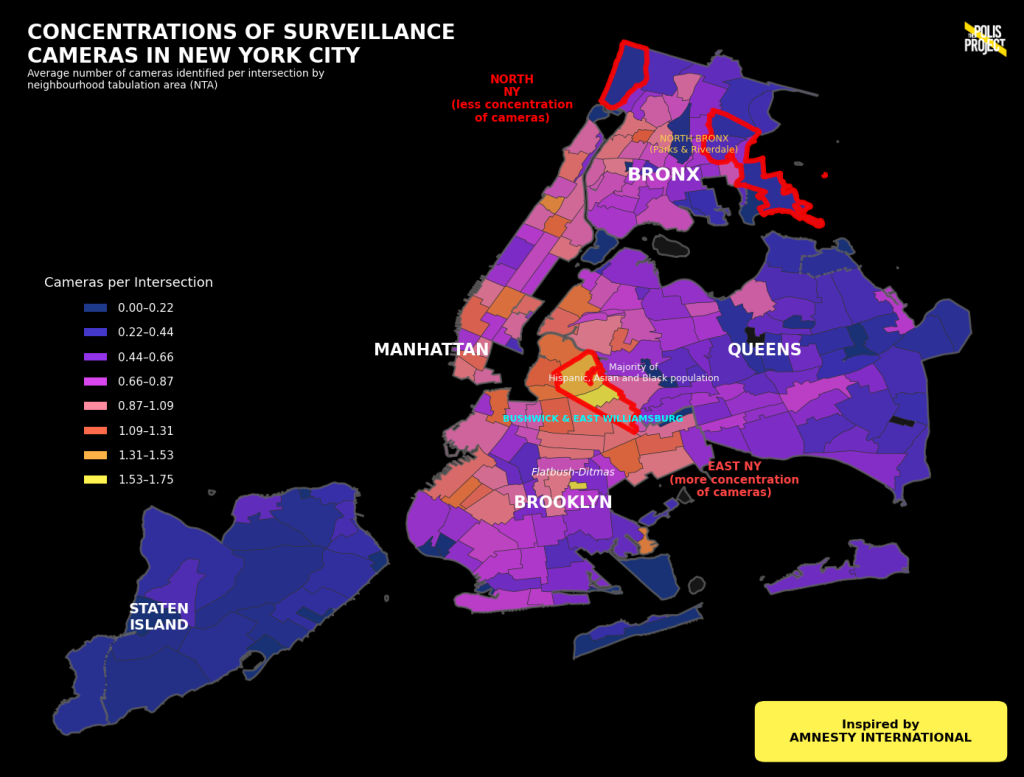
Tisch’s leadership operationalized a broader surveillance ecosystem encompassing facial recognition, gang databases, protest monitoring, and AI-driven analytics stored for years, raising serious privacy and accountability concerns, all while recasting private profits as public security through foundation-funded pilots. A stark example emerged in 2020 when the NYPD’s Facial Identification Section used DAS-linked facial recognition to misidentify BLM protester Derrick “Dwreck” Ingram from an Instagram photo, wrongly flagging him for assaulting an officer, and sending dozens of riot-geared officers, helicopters, and dogs to besiege his Hell’s Kitchen apartment for five hours without a warrant.
DAS and related advancements have turned officers into mobile data nodes, preempting what is alleged as “violence propensity”—a risk score derived from historical arrest data, social network analysis, and geospatial patterns to forecast who is likely to perpetrate or suffer gun violence, often flagging Black and Latino residents in over-policed areas before any crime occurs.
This approach, as the NAACP warns, inherits biases from discriminatory policing data, entrenching cycles of surveillance and pretextual stops—police-initiated halts for trivial violations like a dim taillight to probe deeper suspicions in racialized spaces. Black theorists like Simone Browne and Ruha Benjamin have called this phenomenon the “New Jim Code,” where biased legacy data from 11 million disproportionately Black and Brown arrest records—themselves products of discriminatory stop-and-frisk and over-policing—fuels algorithms that encode anti-Blackness, by automating racial hierarchies under a veil of technocratic neutrality.
Benjamin describes it as high-tech discrimination that appears race-neutral yet reifies inequities through coded bias, while Browne traces its roots to slavery-era surveillance like lantern laws, rendering Black bodies hypervisible yet politically invisible. Applied to NYPD’s DAS, this manifests as algorithms trained on skewed data that perpetuate cycles of profiling and containment in communities of color.
Tisch’s role as Deputy Commissioner for Information Technology between 2014 and 2019 also intersected with the NYPD’s growing international collaborations, including her November 2015 trip to occupied Palestine, where she trained with Israeli Occupation Forces on surveillance integration—learning tactics like real-time data fusion and predictive tools, facilitated by the occupation’s biometric checkpoints and AI targeting.

Tweet from x.com
This exchange occurred amid longstanding NYPD-IOF ties, facilitated by the Tisch family-backed Police Foundation’s International Liaison Program, which maintains an office in Kafr Saba, Israel, and promotes cross-training in predictive analytics and real-time data systems that are imported for use in DAS and officer smartphones.
These “occupation-style tactics”—such as AI-driven profiling and mass surveillance—have been deployed against NYC protesters, Muslims, and Black/Latino communities, mirroring the IOF methods critiqued by Mayor Zohran Mamdani, who stated the IOF trained NYPD officers. His comment prompted backlash from pro-police and pro-Israel actors, including rival candidates like Curtis Sliwa, Fox News, CBS, and Jewish organizations such as the Anti-Defamation League (ADL), American Jewish Committee (AJC), UJA-Federation of New York, Jewish Community Relations Council of New York, and New York Board of Rabbis, who framed it as anti-NYPD and antisemitic.
In sum, Tisch’s legacy as Deputy Commissioner for Information Technology between 2014 and 2019 lies in transforming NYPD operations and merging counterterrorism, data analytics, and everyday policing into a mammoth surveillance infrastructure, with global effects including expanded international liaison programs stationing NYPD detectives in 11 countries including Israel, the UAE, France, and Australia funded by the Police Foundation and foreign governments, cross-training exchanges and collaborations such as with Ghana Police Service on regional security tactics.
At the heart of Commissioner Tisch’s policies is not only the construction of a surveillance regime, but also the implementation of anti-people, anti-poor, racialized policy that lands—predictably and repeatedly—on the most racially, economically, and politically marginalized communities in this city.
One of the deadliest blows to communities of color under Commissioner Tisch has been the return of the “broken windows” policy by way of trash enforcement and quality‑of‑life policing, transforming everyday life in Black, Brown, immigrant, and unhoused neighborhoods into a site of continuous monitoring, data extraction, and punishment.
NYPD launched Quality-of-Life squads (Q-Teams) in April 2025 as precinct-based squads targeting non-emergency 311/911 complaints like noise, homeless encampments, illegal e-bikes, vendors, and drug use— a covert revival of 1990s broken windows policing rebranded as quality of life harassment, and proven inefficient and deadly for communities of color. Broken windows policing, theorized by James Q. Wilson and George L. Kelling in their 1982 Atlantic article, argued that visible signs of disorder—such as broken windows, graffiti, loitering, or fare evasion—signal neglect, erode community norms, and invite escalating crime if ignored.
In practice, it fueled 1990s NYPD strategies under William Bratton and Rudy Giuliani, emphasizing aggressive misdemeanor enforcement via CompStat that fueled discriminatory stop-and-frisk and over-policing of poor/minority neighborhoods without addressing root causes. Under Tisch, its revival via Q-teams targeting minor offenses mirrors this zero-tolerance logic, supercharged by DAS surveillance.
Expanded across all five boroughs by August amid 100–2,000% complaint spikes since 2018, Q-Teams disproportionately hit Black, Latino, immigrant, and homeless groups.
By August 2025, they towed 701 vehicles, seized 322 e-bikes (mostly immigrant workers’), cleared 1,412 encampments—tracked via Q-Stat dashboards echoing CompStat—mirroring 1990s misdemeanor surges, despite Tisch/Adams zero-tolerance denials, ignoring root causes like poverty and housing shortages.
Similarly, Tisch’s camera-heavy “trash enforcement” created a sanitation surveillance grid that mirrors and fuels NYPD policing infrastructures like Q-Teams, blurring waste management with the criminalization of Black, Brown, immigrant, and unhoused people already structurally coded as disposable. The outcome is that police violence is now administratively acceptable and survivable. The city continues to police poorer neighborhoods with suspicion, and public safety becomes unevenly distributed, enjoyed as a privilege rather than lived as a right.
Mamdani is hoping to reform the nature of police brutality and violence against New Yorkers, and the NYPD’s consistent, systematic failure, across various commissioners, and to hold police officers accountable. Today, the NYPD enjoys impunity as policy, and Tisch, like previous commissioners, has entrenched that pattern.
Commissioner Tisch overrode more than 25 misconduct cases substantiated by the Civilian Complaint Review Board (CCRB) in her first year in the role, including serious excessive-force incidents like a detective punching a woman and officers breaking a handcuffed man’s arm, prioritizing internal loyalty over civilian oversight amid patterns of police violence.
A 2025 federal lawsuit named Tisch and the NYPD for systemic unlawful stops, echoing the NY AG’s findings on one sergeant. David Grieco’s pattern of Fourth Amendment violations, including 2018 warrantless searches, yet Grieco received only minor discipline: formalized training, forfeited vacation days, and instructions, with later cases dismissed due to delays in charging and trials. Similarly, FOIA on trial outcomes and CCRB youth and mental health data reveal consistent delays in serving charges, prosecuting cases, and imposing discipline against these officers.
For the unarmed Delrawn Small’s roadside execution by Officer Wayne Isaacs in front of his infant and fiancée, 33 elected officials urged Tisch in November 2025 to reject Isaacs’ dismissal motion after Deputy Commissioner Rosemarie Maldonado’s recommendation. The trial stalled past its November 19–21 dates, with advocates pointing to nine years of obstruction across commissioners, including Tisch.
As Israel’s genocide in Gaza intensified, New York City became the epicentre of Gaza solidarity protests. Tisch herself oversaw aggressive crackdowns on the protests and protestors, including sanctioning Columbia University arrests in riot gear from 2023 to 2025. Additionally, training that labeled keffiyehs and watermelons as antisemitic was employed in partnership with the Anti-Defamation League and Israeli officials, and NYC’s facial recognition ban was bypassed via New York Fire Department (FDNY) marshals to identify pro-Palestinian student protesters using high school graduation photos.
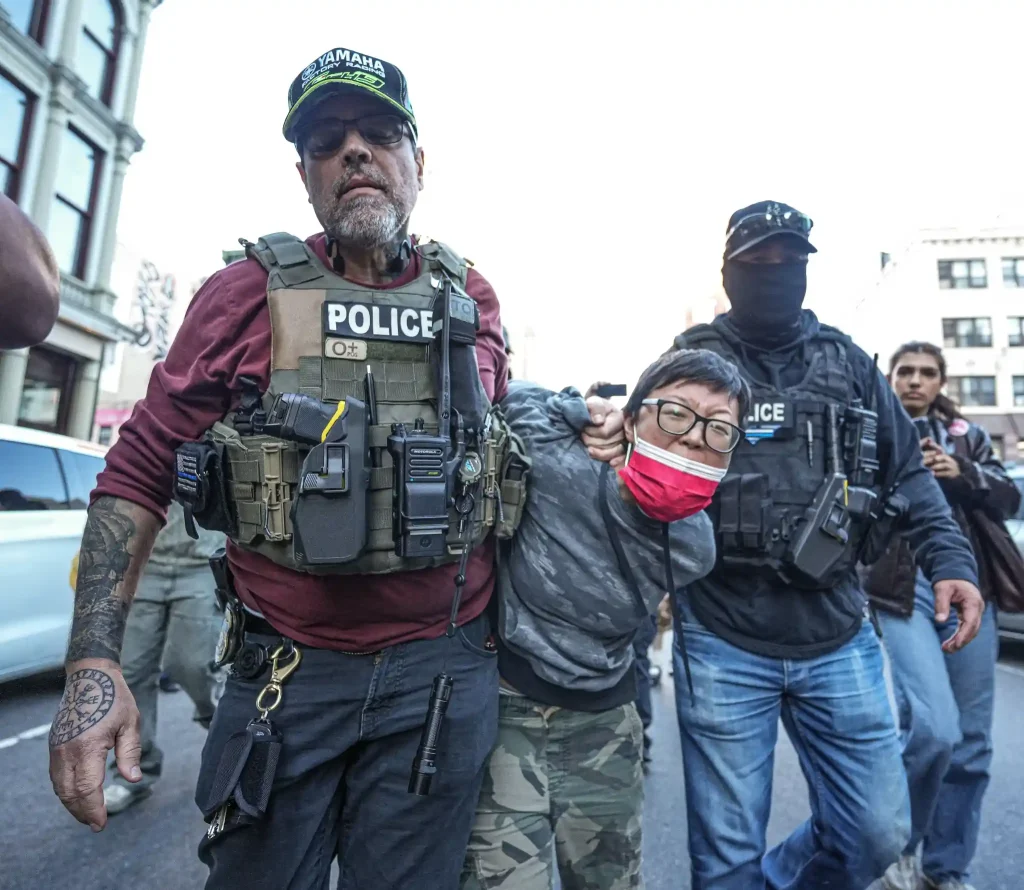
Speaking to reporter Samantha Maldonado, Albert Fox Cahn, executive director of the Surveillance Technology Oversight Project, said, “The NYPD keeps using these incredibly disturbing companies to spy on New Yorkers, while hiding that surveillance from the public and violating New York City law in the process.”
Commissioner Tisch’s speech defending Gaza operations at an Anti-Defamation League event last year prompted a letter from more than 3,500 public defenders of the Association of Legal Aid Attorneys (ALAA) UAW Local 2325) urging Mamdani to oust her for surveillance and protest repression. An open letter from 121 groups also cited her Zionist ties and hosting the Netanyahu family by the Tisch Family.
While former Mayor Eric Adams campaigned on strict sanctuary enforcement, he shifted his position after Trump’s 2025 inauguration, authorizing “limited” NYPD-ICE “deconfliction” amid federal demands for mass deportations and framing the violation as criminal-nexus cooperation. Commissioner Tisch has defended these actions as “exigent.” Under her, the NYPD has engaged in documented collaborations with ICE and other federal agencies that tested New York City’s sanctuary laws, amid federal pressures for deportations.
While Tisch has publicly reaffirmed non-cooperation with civil immigration enforcement through memos and statements, investigations revealed policy gaps, inadequate documentation, and isolated violations where officers shared data or facilitated transfers under criminal pretexts that enabled civil detentions.
DOI’s December 2025 probe, prompted by the City Council, examined five cases from 2024-2025 and confirmed one clear violation: a gang task force officer of Homeland Security Investigations (HSI), a unit of ICE, gang task force officer placed automated alerts on civil immigration targets in NYPD systems in November 2024. Other cases skirted boundaries, including the February 2025 Merwil Gutiérrez Flores transfer to the FBI/HSI after the DA declined to prosecute for firearms, leading to civil detention, and the March 2025 Leqaa Kordia disclosure of sealed records to HSI under a money-laundering claim, sparking an internal NYPD probe.
The October 2025 Canal Street ICE raid saw Tisch order NYPD to stand down after a federal tip-off, arresting 9-12 undocumented vendors on counterfeit goods charges, framed as non-involvement to comply with sanctuary rules.
Tisch and Mamdani fundamentally disagree on many issues. Tisch opposes bail reform, blaming it for recidivism, the abolition of the SRG database, and curbs on the National Guard—these contrast with Mamdani’s pandemic-time crime frame and demilitarization pledges.
Her family’s PACs opposed Mayor Mamdani’s run, and her brother Benjamin labeled him a “Jewish enemy.” While Tisch apologized for that comment, future flashpoints likely include budget cuts, resistance to ICE raids amid Trump pressure, and protest policies. These will test whether Mamdani tames the NYPD or Tisch entrenches the status quo.
Tisch staunchly defends the NYPD’s Criminal Group Database, opposing Mamdani’s pledge to abolish it despite documented biases. Tracking 13,304 alleged gang members (99% Black and Hispanic, per a 2023 DOI report), it relies on vague criteria such as neighborhood, social media, or NYCHA residency; youth under 18 receive no notification or appeal. In April 2025, Tisch touted the success of a joint task force with federal agencies during a press conference announcing 16 indictments against the “LA World” and “Wuski” gangs.
She praised the collaboration as key to public safety, arguing it helped dismantle violent networks operating in New York City. Tisch strongly opposed a City Council Bill, introduced by Bronx City Council Member Althea Stevens, that aims to abolish the database and prohibit the establishment of any replacement. Tisch said that the “Calls to get rid of this tool are dangerous. They fly in the face of public safety.”
Despite NYC’s sanctuary policies restricting civil immigration enforcement, Tisch framed these efforts as focused solely on criminal activity, maintaining the department’s official stance while publicly defending the operations.
Tisch will resist Mamdani’s demilitarization, including National Guard curbs, amid her counterterrorism background and pro-expansion stance– “we need more cops”. Before taking office, Mamdani reiterated that he would not fire cops en masse, signaling continuity with Tisch’s leadership despite policy tensions.
Mayor Mamdani said in his inauguration speech that he was not in the business of resetting expectations and that his governance would be audacious. If we take him at his word, then the first test is one of accountability.
Even so, Mamdani has walked back his initial position of defunding the police, explicitly stating in July 2025, “I am not defunding the police; I am not running to defund the police,” after 2020 tweets calling to “Defund it. Dismantle it.” Will Mayor Mamdani counter Commissioner Tisch’s positions on surveillance and protest policies? If so, what will those policy challenges look like? Many have already predicted that it is highly likely that Mamdani will choose the path of pragmatic compromise, given the unlikely alliance that Mamdani has forged with Tisch.
We will watch whether CCRB findings continue to be overridden, and whether the city finally dismantles the architecture that has made police brutality and violence structurally survivable. Second, can Mayor Mamdani govern a mammoth infrastructure of surveillance and militarized police he inherits, wired into the city’s bloodstream, budgets, and contracts? Can he disrupt and dismantle the long afterlife of broken windows policing, returning through various policies?
Then comes the question that will define sanctuary in practice: how will Mamdani confront the NYPD’s complicity with ICE, and how will he rebuild protections?
And when New York’s pro-Palestinian protests and other public uprisings re-emerge, what doctrine will rule the streets? Will he rein in the NYPD’s violent and brutal protest policing and safeguard civil liberties, or will audacity collapse into a request for restraint?