
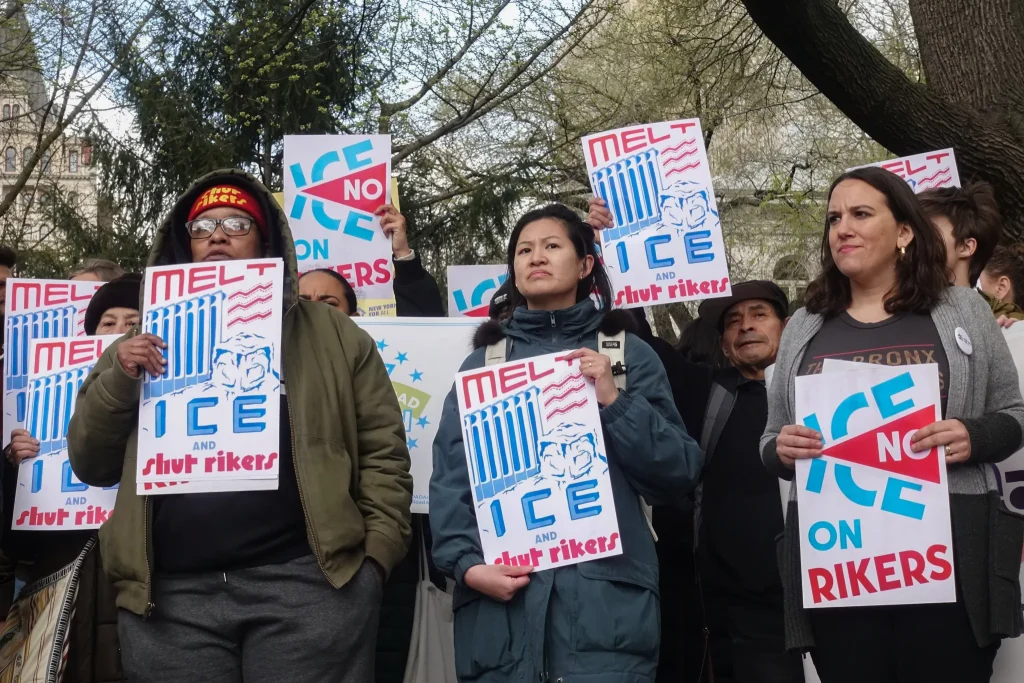
Demonstrators rally outside City Hall against Mayor Eric Adams' executive order allowing ICE and other federal agencies back onto Rikers Island, April 10, 2025. Credit: Gwynne Hogan/THE CITY
Mayor Zohran Mamdani closed the chapter on an Adams-era executive order that would have given Immigration and Customs Enforcement (ICE) — and the Trump administration — a greater foothold on the Rikers Island jail complex, but advocates say the loophole behind it persists, and so does the risk of immigration enforcement inside the jail complex.
The move came just a few days before the tragic shooting death of Renee Nicole Good, a U.S. citizen, and mother to a young child, on January 7th. A video of the murder showed ICE agents surrounding Good’s car, and then firing into the vehicle as it appeared to be driving away. The shooting has sparked outrage from Minneapolis Mayor Jacob Frey, who then told ICE to “get the f— out of” the city.
Mamdani is also contending with U.S. Secretary of Homeland Security Kristi Noem’s visit to NYC, who called Good’s alleged actions “domestic terrorism.” He had this to say during a press briefing, cementing New York’s status as a sanctuary city: “we are going to take every opportunity we have to inform New Yorkers…and also to make it clear to our own city government agencies and departments across the board, including NYPD, that we are not here to assist ICE agents in their work. We are here to follow the laws of New York City.”
On his first day in office, Mamdani revoked all of Former Mayor Adams’s orders signed after September 2024, when Adams was indicted on federal corruption charges. One of the now-revoked orders would have reopened an ICE office – that has been closed since 2014 – on the city jail complex, and federal immigration enforcement officers would have been able to interview inmates about whether they entered the country illegally and start removal proceedings.
Adams signed the executive order shortly after federal prosecutors dropped the corruption charges against him, following arguments by the Trump administration that the case was hindering Adams’s cooperation with an immigration crackdown. The New York City Council filed a lawsuit contending that the order is unlawful and tainted by a “corrupt bargain” with the federal government in order to seek an immediate halt to the implementation of the order. A New York State Supreme Court judge declared the order “null and void,” citing an “impermissible appearance of a conflict of interest” between Adams and Trump.
“It’s great to put this issue to rest,” Meghna Philip, the Director of the Special Litigation Unit at The Legal Aid Society, told Polis Project. “In terms of revoking this executive order, which was tainted by both a quid pro quo between Eric Adams and the federal administration and was also clearly aimed at opening the door to constitutional violations, racial profiling, and wrongful deportations by ICE on Rikers Island – it’s great that it’s revoked.”
Adams used a provision in the city’s sanctuary laws that permits a mayor to allow access to immigration enforcement for “purposes unrelated to the enforcement of civil immigration laws,” which is a clause included in the city’s Local Law 58, pertaining to people not to be detained by the Department of Corrections (DOC). The City Council passed a bill that would close this loophole and prevent ICE from having an office on any land overseen by the Department of Corrections. The goal was to put a moratorium on the issue. Adams vetoed it on his final day in office.
“We believed that even though we had an incoming administration that was supportive, our local laws also needed to be updated in order to ensure that no future mayor would seek to exploit and undermine our laws by issuing an executive order,” said Yasmine Farhang, from the Immigrant Defense Project.
Farhang and Philip said that they expect the city council to override the veto because there is a supermajority in support of this law.
Prior to 2014, federal immigration officers had a trailer office at Rikers from which they conducted mass deportations of thousands of undocumented immigrants. This is despite NYC’s history of being a ‘sanctuary city,’ which actually began in the 1980s under Mayor Ed Koch and then was expanded by both Mayors Bloomberg and De Blasio.
Since 2014, those at Rikers have not been entirely safe from the threat of deportation, but the pipeline from the criminal legal system to deportation became somewhat less streamlined after De Blasio expelled the federal agency by codifying and passing the sanctuary laws.
Rikers Island — a 400-acre island in the East River that houses the biggest jail complex in the city — has a decades-long history of violence towards incarcerated individuals, medical neglect, mismanagement, and subpar living conditions. City leaders have pledged to close it by August 2027 following years of federal oversight and damning reports. However, the current Rikers population exceeds the capacity of the borough-based jails that are intended to replace the jail complex — some of which are not finished being built yet. In August 2025, a federal judge ordered that the jail be put under third-party control to address long-standing safety issues.
As of spring 2025, there were around 7,000 people on Rikers, and over 80 percent are pretrial defendants who have either not yet gone through their trial or even been given a trial date.
Between 2004 and 2009, 13,000 Rikers inmates were placed in deportation proceedings. When immigration enforcement operated on Rikers, they had unlimited access to the inmates and could conduct proceedings with full support of the Department of Corrections.
Rosa Cohen-Cruz, the Immigration Policy Director at The Bronx Defenders, told Polis Project that having an ICE office on Rikers negatively impacted people who were trying to navigate the criminal legal system by adding a coercive element that made people feel like they had to take plea deals or delay their cases so that they wouldn’t end up immediately in ICE custody.
“For sanctuary laws, guarantees of protections, due process, and core principles like fairness to matter, they need to be equally applicable to all people,” said Cohen-Cruz. “That includes people with convictions, that includes people who are born anywhere in the world. The minute we start to chip away at who gets these fundamental protections, that is when we’re weakening the protections for everybody. It is really critical that we ensure that these are bright-line rules that apply to all people and not try to make policy assessments about who is deserving of these core fundamental protections and who is not.”
Abraham Paulos, the deputy director at Black Alliance for Just Immigration, has himself faced the threat of deportation at Rikers when he was arrested in 2010 for a robbery charge. Paulos was later acquitted and able to leave Rikers, avoiding any ICE interaction.’
“You’re talking about a situation with the New York Police Department, which profiles and targets black and brown residents in New York City,” said Paulos. “Then you have a situation where they’re on Riker’s Island, and this is giving ICE essentially access to…black and brown New Yorkers who might be innocent. It’s a perfect storm for fishing in a barrel [for ICE]. They just go in there and literally just stick their hand in the barrel, and they’re going to get a bunch of people.”
But even with this executive order revoked and the city’s sanctuary status, the Department of Corrections (DOC) has been found collaborating with ICE. In 2023, emails between ICE and DOC officers were released that show clear cooperation between members of the agencies. A captain of the DOC used the hashtag “#teamsendthemback” in two of the released emails, where she shared the release time of a person in custody. In September 2025, an internal investigation found that a DOC investigator provided information to federal immigration authorities on two people who were in custody.
Philip said that revoking the Adams executive order was a good first step, but that there is a lot to be done to protect immigrants in the city’s criminal legal system.
“In terms of our city government and city agencies, there is more that can be done to ensure that they are not participating, whether purposely or inadvertently, with federal immigration enforcement,” said Philip. “We want to see this administration really take a bold stance through administrative change at the level of all of these agencies that they should under no circumstances be funneling people and their information and New York’s information to federal immigration authorities.”
Paulos and Philip said that it would be an important step for Mamdani to issue clear guidance on how city agencies should deal with federal immigration enforcement.
Part of the reason why DOC is able to collaborate with ICE is that there is not a good mechanism for accountability, but there is a bill that advocates are calling the “Trust Act,” which would allow an individual to sue the city if its agencies unlawfully cooperate with federal immigration authorities.
“[Revoking the Adams executive order] is a very necessary first step to help disentangle New York from colluding with ICE, but there’s a lot more to be done to really make sure that our sanctuary laws are stronger and are followed by the agencies that have already unfortunately been found to have violated them in the past,” said Cohen-Cruz. “The Mayor can work with the City Council to strengthen the city’s sanctuary laws and ensure that some of the loopholes that have been taken advantage of in the past are closed and that the laws are really the strongest possible that the city can offer. That would include the passage of the New York City Trust Act.”
We like bringing the stories that don’t get told to you. For that, we need your support. However small, we would appreciate it.
This is not a paywall.