
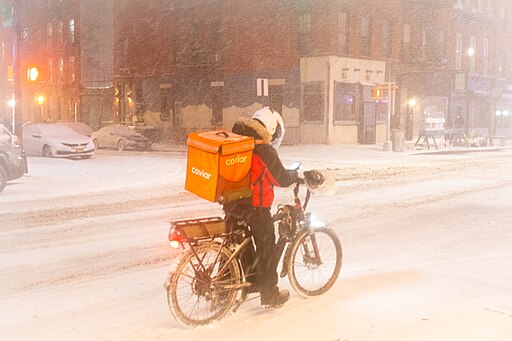
A food delivery worker biking in the snow
As part of the Mamdani administration’s efforts to protect workers and hold big businesses accountable to their customers, nearly 50,000 food delivery workers in New York City will receive $5 million in restitution from major restaurant delivery app companies.
During a press conference held in a Long Island City food hall on Jan. 30, Mamdani and the Department of Consumer and Worker Protection (DCWP) Commissioner Sam Levine announced that Uber Eats, Fantuan, and HungryPanda will pay a combined $5,195,000 in restitution, civil penalties, and damages after a DCWP investigation found that the companies failed to pay workers the city’s minimum pay rate between December 2023 and February 2024.
“If you are one of the tens of thousands of New Yorkers who makes ends meet in our city as a delivery worker, your daily life can be described in a single word: relentless,” said Mamdani. “The expectation that you show up to work, that you bike through the rain or through the heat or through snow drifts— it is relentless. The bills you have to meet, the costs that keep on rising. It is relentless, and the mistreatment that too many delivery workers are subjected to by the massive impossibly wealthy corporations that they work for— that is no less relentless.”
In 2023, the city passed legislation legally requiring restaurant app companies to pay a minimum wage to delivery workers which is set to be $22.13 this year.
Los Deliveristas Unidos, a subgroup of the advocacy center Workers Justice Project, collaborated with City Hall on securing the settlement. The organization empowers low-earning immigrant workers to fight for better workplace standards across construction, house cleaning and app-based delivery industries. Because most of the city’s estimated 80,000 food delivery workers are classified as independent contractors or gig workers, they are exempt from many labor standards and worker protections, Ligia Guallpa, co-founder of Los Deliveristas Unidos, told The Polis Project. This leaves workers vulnerable to exploitation and unsafe working conditions.
“What we’ve been doing here in New York is sort of leading the way on how gig workers who traditionally have been excluded from labor protections can lead the way [in reclaiming] rights that they were denied,” Guallpa said. She noted that the ultimate goal is for the 80,000 or so delivery app workers in the city, who have been working in sub-freezing temperatures and snow of late, “to have pathways not only to unionization, but also a pathway for economic prosperity so they can afford to live in the city of New York with dignity.”
The DCWP identified the violations by pairing the apps’ monthly reporting obligations with direct testimonies and records provided by workers. Uber Eats, which will pay the majority of the settlement, failed to compensate workers for time spent on canceled trips even when the cancellation was not the fault of the worker, whereas HungryPanda and Fantuan failed to pay the minimum pay rate overall. Uber will also pay damages to workers they wrongfully deactivated between December 2023 and September 2024, which nearly 10,000 people are eligible for.
“When the City Council passes a law to protect workers, we mean it. Mayor Mamdani and DCWP are taking enforcement seriously, and workers are going to see the difference in their pockets,” Council Member and Majority Leader Shaun Abreu told The Polis Project. “The $5 million settlement over violations of the minimum wage law sends a message to the apps that we are holding them accountable and will make sure that deliveristas receive every cent they’ve earned.”
This is not the administration’s only battle against delivery companies right now. Earlier this month, Levine announced a lawsuit against the delivery app Motoclick for not complying with the minimum pay rate and charging workers for canceled or refunded orders. DCWP also sent compliance warnings to over 60 companies such as Instacart, DoorDash and Grubhub to adhere to recently expanded delivery worker protection laws, such as increasing delivery worker pay transparency, improving bathroom access for contracted delivery workers, and requiring all restaurant and grocery apps to offer a tipping option at checkout.
While the restitution leaves a historic mark in the expansion of labor protections, Guallpa says there’s still more work to do. She hopes Los Deliveristas Unidos can continue working with the Mamdani administration on measures such as increasing the minimum pay rate to $35 an hour, closing legal loopholes in existing legislation, and building an entire formal network of delivery worker hubs across the city.
In New York City, workers, who come from majority immigrant backgrounds, complete around 2.7 million food deliveries per week. As ICE raids rampage through communities throughout the nation, and the impending threat looms within the city, Guallpa wants to encourage workers to not fear coming forward to demand basic labor protections, but to also know the rights they have as immigrants and residents.
“We are super excited to see a mayor who has demonstrated that he’s committed to standing up and also protecting deliveristas,” she said. “I think he has shown in the first month that deliveristas are part of his affordability policy agenda. And we’re looking forward to continuing that partnership, not only to ensure that the rights that we want are enforced, but to expand more labor protections while defending our communities from ICE. “
Earlier this month, Mamdani held a meet and greet with delivery workers to discuss their current concerns.
Guallpa, relaying a sentiment from one of the workers in attendance, said: “I remember one of the deliveristas, Alejandro, said ‘We finally feel that we’re not alone.’”
We like bringing the stories that don’t get told to you. For that, we need your support. However small, we would appreciate it.
This is not a paywall.