
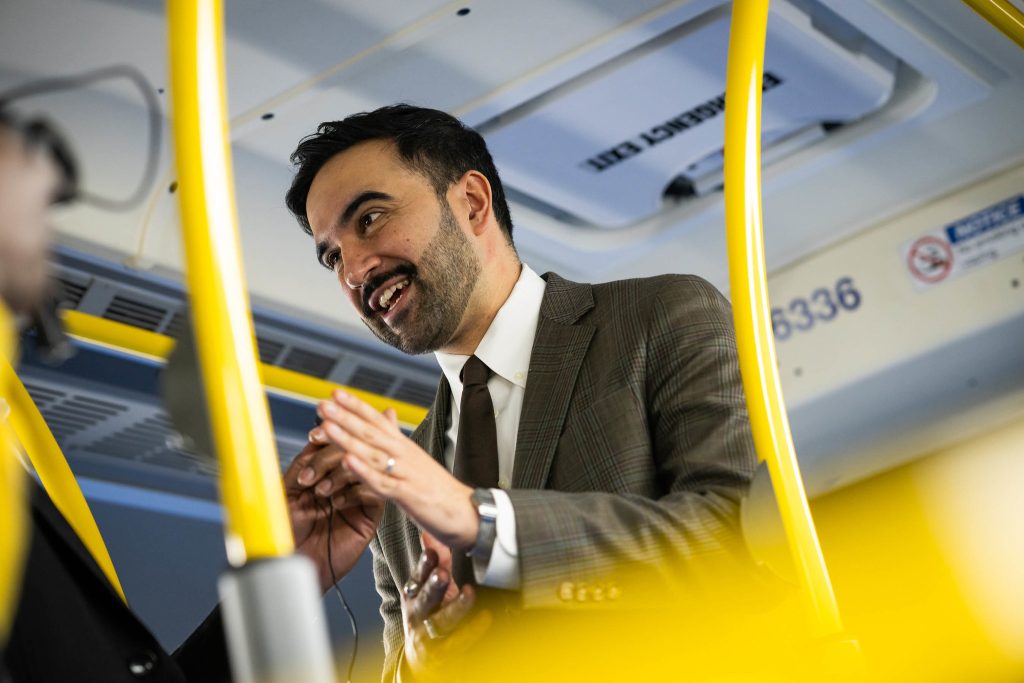
West Farms Bus Depot, Bronx. Friday, February 13, 2026. Credit: Ed Reed/Mayoral Photography Office.
In February, Mayor Zohran Mamdani floated the idea of testing system-wide free bus service in New York during the World Cup this summer. The Metropolitan Transportation Authority (MTA), on the other hand, said that no one from the city or state government contacted the authority about this proposal. The MTA plans instead to implement stricter enforcement on buses by hiring fare inspectors to check passengers once they are on board.
While the debate over free buses continues, public transit is under attack by the Trump administration. The White House is working to urge Congress to pass laws to stop large cities that receive federal funding from providing free buses.
Transit advocates see this move as a response driven by resentment toward Mayor Mamdani’s popular promise of fast-and-free buses for New Yorkers, a case of what advocates often call ‘trolling rather than governing.’ Mamdani’s strategy was prompted by a decade-long history of community organizing for affordable public transit in New York.
The Trump administration is not the only actor gunning against Mamdani’s plan for fast-and-free buses. Surprising opponents of free transit are climate advocates and transit researchers, some of whom argue that there is little to no evidence that fare-free transit does much for reducing air pollution or carbon emissions.
In New York, transportation accounts for more than 25% of the city’s greenhouse gas emissions. Opponents of free transit argue that there’s no guarantee that free buses will lead to more riders adopting buses, or transition from using their cars to public transit which would benefit air quality and decrease emissions.
Fast-and-free buses – a climate policy?
In their analysis of cities implementing free public transport, The International Association of Public Transport (UITP) found that there is limited impact on car use; most new riders shifting to public transit were people who previously walked or biked.. One environmental economist evaluated Colorado’s “Zero Fare for Better Air” program, finding there was no evidence free public transit led to a decrease in local ozone air pollution—instead it increased from 2.2% to 4.2% during August 2022.
Bloomberg CityLab argued that providing free transit to those of “limited means is societally valuable,” but does nothing to help reduce emissions. The Washington Post editorialized against Mamdani’s fast-and-free bus policy, arguing that it would “only make things worse,” and risk turning buses into “de-facto homeless shelters.”
“There’s no evidence at all that cities introducing fare-free and public transport have seen their car traffic reduced,” said Mohamed Mezghani, the secretary general of the International Association of Public Transport.
However, there is evidence that free buses have worked in shifting car-dependent behaviors and reducing emissions. The MTA evaluated its own free bus pilot in New York City, and found that ridership increased by 30% on weekdays and 38% on weekends on every free bus route; and that 11% of new riders would have taken a taxi or driven instead.
After making all transit free, the city of Dunkirk in France found 10% of bus riders abandoned their cars since 2018, cutting the use of city parking lots by 30 %. Iowa City eliminated bus fares in August 2023 as part of a pilot program, finding it led to ridership increasing by 18% compared to pre-COVID levels, and a drop in emissions by 778 metric tons of carbon dioxide a year. North Carolina’s Chapel Hill Transit went fare-free 20 years ago, and its ridership more than doubled from 2002 to 2020. Upgrading the fleet to hybrid-electric buses led to a 15% annual decrease in emissions compared to 2005 levels. The fare-free bus pilot in Boston found that if all buses were free, there would be a 2% decrease in the city’s total emissions.
It is unlikely that the literature will settle the debate about the benefits and challenges of fare-free transit, Kevin Shen, a transportation expert at the Union of Concerned Scientists, told The Polis Project. Instead, he argues the emphasis should be on shifting people towards public transit – which benefits households and over the long-term, lowers air pollution and helps combat climate change. Shen argues there is enough evidence to conclude that free fares and improved services do increase ridership on transit.
Moving beyond carbon tunnel vision
“Free buses are one piece of the puzzle. We also need electric buses on our routes as well,” Kevin Garcia, a transportation expert at the NYC Environmental Justice Alliance, told Polis Project.
Some neighborhoods – mostly those north of 110th Street in Manhattan and many in the Bronx, Brooklyn, and Queens – have been designated as ‘environmental justice areas’ by the Mayor’s Office of Environment and Climate Justice. Here, low-income residents and communities of color suffer from disproportionate air and ground pollution and associated health risks, and have less access to green space and reliable public transportation.
For Garcia, while buses serve these communities, they can also be a source of pollution because of idling, and the concentration of bus depots in these neighborhoods. “Even though folks rely on bus services, they shouldn’t have to be harmed by the service,” added Garcia.
Climate policy has also had to reckon with its tendency to develop “carbon tunnel vision.” Structural issues that drive environmental injustice – the broader perspectives on how people relate to the natural and built environment or face injustice at the hands of policy made by those outside of their communities – are pushed aside at the expense of policies hyper-focused on emissions reduction.
For Mela Bush-Miles, Coordinator of Transit Equity and Environmental Justice with nonprofit coalition Action4Equity, organizing has a big role to play in making sure transit does not harm communities. Bush-Miles previously laid the groundwork for the free bus program in Boston.
“Planners are not connected to those who are being planned for,” Bush-Miles told Polis Project. She argued that narrowly focusing on emissions reduction overlooks the reality of the needs of the people who are transit-dependent, very few of whom own cars and therefore are residents who already contribute less to greenhouse gas emissions.
Fare-free transit helps people overcome negative experiences of using public transit. “It maintains people’s dignity, so they don’t have to beg to get on the bus,” Bush-Miles added.
Environmental policy has been plagued with a history of racism, ignoring the needs of and harming communities of color. Couple that with the fact that low-income communities and communities of color are historically harmed by highways and transportation services and the construction of those infrastructure projects, rather than benefitting from them. The Cross-Bronx Expressway, for example, is a highway that tore through the heart of the Bronx, segregating and displacing Jewish, Italian, Irish and Black communities during and after its construction.
All the while, the lack of affordable and reliable transit services limit opportunities for communities to access jobs, cleaner air, and a better quality of life.
An analysis of how well public transit serves riders by TransitCenter, a grantmaking foundation, found in 2022 that Asian, Latino, and Black residents in NYC had access to 14%, 22%, and 44% fewer jobs, respectively, than their white counterparts, likely due to high housing costs and legacies of segregation. A quarter of New Yorkers living in poverty struggled to afford subway or bus fares, with Hispanic and Black residents reporting the highest rates of transit hardship across racial groups. That hardship is also costing the city money that could be used to improve the MTA’s infrastructure. In 2024, the Citizens Budget Commission calculated that more than 700 people were evading bus fares every minute, resulting in a loss of $1 billion in revenue.
One important element of Mayor Mamdani’s campaign promise was his emphasis on not just making buses free, but also on providing faster service. In early February, Mamdani announced plans to move forward with offset bus lanes on Fordham Road in the Bronx, the borough’s busiest bus corridor and where Mamdani said “buses creep along at four miles per hour.” The lanes are intended to help increase bus speeds for the more than 130,000 riders who rely on them,
The city expects up to a 28% improvement in bus speeds, based on similar efforts in Queens.
“Fast and free buses are appealing because bus riders in New York are overwhelmingly short on money and short on time,” said Danny Pearlstein, Policy and Communications Director at the Riders Alliance, a transit organizing group in New York that worked with Mamdani on the first free bus pilot in the city.
Another benefit of free transit is that people take it for reasons other than commuting to work, which reduces cost burdens for people who are struggling to pay for daily expenses while being able to go grocery shopping, to the doctor, or to see loved ones, Emmett Hopkins, senior transportation manager at the Climate and Community Institute, told Polis Project. “Often in political or policy discourse, there’s a focus on factors that may ignore just the basic equity of making sure that everyone has an affordable, reliable, safe way to get where they need to go,” added Hopkins.
However, critics argue free buses could affect transit revenue, including how much money is available to purchase and deploy electric buses. While funding for transit agencies is complex, money for fleet upgrades are generally funded through state or federal capital grants, not from fare revenue, which covers operating costs, service improvements, and partly paying bus drivers.
For Shen, asking people or transit agencies to choose between free buses, electric buses, or paying bus drivers is a scenario of false options. “If we’re really going to open that question of where to spend our money…on a societal level, the things we’re thinking about are what does it mean to invest in transit versus roadways?”
Advocates ask for more ambition
Organizers are now asking the Mamdani administration to be more ambitious about affordability, electrification, and public transit.
The auto and oil industries spend over $100 million annually to lobby against funding for public transit, per the Union of Concerned Scientists. The same industries receive more than 75% of public and private transportation spending, according to a report by the Union of Concerned Scientists.
In June 2025, Trump threatened to withhold annual federal funding from state transportation agencies and public transit operators who do not cooperate with Immigration and Customs Enforcement.
A court struck down Trump’s Department of Transportation (DOT) order. Still, DOT has pulled $54 million in grants from university research focused on improving transportation for low-income workers and people of color. The University of California, Davis last year won back the $12 million research grant the DOT had suspended in a federal lawsuit.
While Mamdani’s campaign emphasized buses in the city frequently, a look at his team’s social media posts and his speeches showed he did not speak about climate change or environmental justice with nearly the same frequency. It was largely ignored in the mayoral debates as well.
At a recent commemoration of Rosa Parks’ birthday, transit groups asked the Mayor to expand the existing Fair Fares program, which provides discounted half-fare cards, by raising the threshold of eligibility to 300% of the federal poverty level compared to the current 145% of the federal poverty level.
This would mean a family of four would become eligible for the discounted fares if their income were at or below $100,000 annually. Advocates are also proposing an expansion of eligibility for the free fare program for the subway, arguing it would help avoid the unintended consequences of limiting low-income New Yorkers to using the bus, even though that may not be the most convenient or feasible option for them.
Advocates are essentially pushing Mamdani for more accountable transportation and city infrastructure planning to truly make the city more affordable financially and in terms of public health and equity.
At its core, advocates say, the fight for free transit is about centering the lived experiences of the riders who depend on it most. As Bush-Miles said: “You don’t know someone’s experience until you walk a mile in their shoes, or until you ride a mile on their bus.”
We like bringing the stories that don’t get told to you. For that, we need your support. However small, we would appreciate it.
This is not a paywall.