
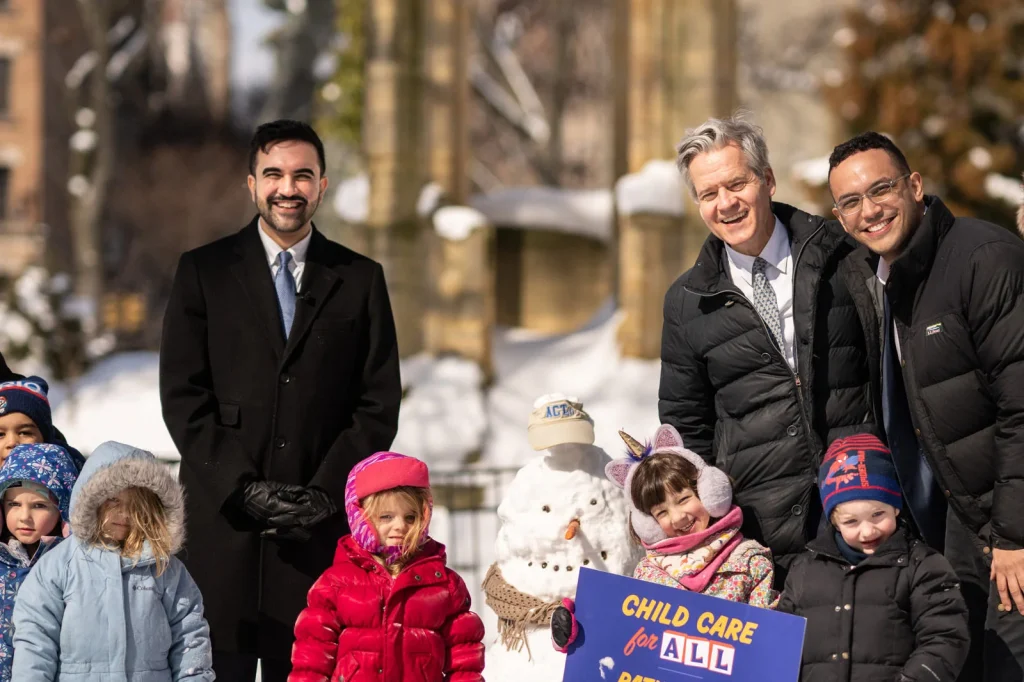
Mayor Zohran Mamdani with NYC preschoolers. Image: NYC Govt., Mayor's Office
Melissa Guzman jokes that people in her Hamilton Heights neighborhood in northern Manhattan call her the “crazy day-care lady.” She runs the Small Idea School out of the first floor of her home, a Victorian townhouse, nestled between two apartment buildings amidst the cacophony of Broadway and Amsterdam Avenue, offering parents affordable day care while they work. Guzman, a graduate of the Bank Street College of Education, believes in the school’s play-based education model and that the residential setting makes for a particularly rich and welcoming learning environment. “We’re like, hugs and kisses at the door …“And is grandma still in town? Is grandma coming to read today because she’s visiting from Argentina?” Guzman said about a typical morning drop-off conversation. Having watched neighborhood kids grow up together and stay in touch long after those first years, and once-isolated parents become each other’s support network, Guzman is much more than a “crazy day care lady”—she’s the loving pillar of a community she’s helped to build.
The expansion of the city’s child-care infrastructure is central to Mayor Mamdani’s affordability agenda. Within his first full week in office, he held a joint press conference on the issue with Governor Hochul, announcing $1.6 billion in state funding and the launch of a program for 2-year-olds—promising first steps towards his stated goal of establishing free universal care. Yet the mayor is inheriting a system bruised by budget cuts, poor management, and negligence under the Adams administration. Significant glitches in the existing pre-K and 3-K programs have yet to be fixed. As campaign promises shift to policy reality, parents, providers, analysts, and politicians are all asking the same question: How, exactly, will the city’s already frail child-care infrastructure be scaled up to meet the needs of all families who need it?
No one is asking this question more than Guzman. She understands the dire need for affordable childcare, and is a supporter of Mamdani’s political agenda. Yet as a provider she can’t help but ask, in a dread-filled tone, “With childcare for all, with the 2-K program, is it going to be the same kind of rollout?”
After starting Small Idea in 2007, Guzman established and staffed additional day cares in separate homes, eventually taking in as many as 85 kids. The client base was steady, and she felt she was fulfilling her mission of making progressive early-childhood education— often limited to expensive Montessori-type programs— accessible to low-income working families. But things started to change around 2014. That was when Mayor Bill de Blasio launched his ambitious, and widely lauded universal pre-K program for four-year-olds, and Small Idea started to lose families to the free city-run program. The drop in enrollment was such a financial hit that Guzman was forced to close her own four-year-old program the following year.
Things only got worse with the launch of 3-K a few years later. The city incorporated home-based day cares like Small Idea into the program to ensure sufficient providers, allowing 3-year-olds to attend them for free. While in theory a positive development in the city’s quest to make childcare more affordable, for Guzman the reality of government-subsidized care meant having to deal with a confusing invoicing system, delayed payments, intrusive third-party networks contracted as a go-between by the Education Department, and—most significantly—arbitrary reimbursement rates that didn’t cover the true cost of care.
“Honestly, [the free 3-K initiative] took me out,” Guzman sighs, exasperated. She has recently had to close two day care centers because she could no longer cover rent and lost skilled staff, shrinking her operation from 85 to 16 kids. “It’s been disastrous,” Guzman said, noting she used to be able to afford to pay for her own health insurance from the revenue, but can no longer afford to do so.
A Patch in the Patchwork
Home-based day cares like Small Idea, also known as family childcare providers, are a vital part of New York City’s patchwork child-care infrastructure, with roughly 10,000 of them licensed to operate in the five boroughs. Compared to school-based day cares run by the Education Department, or center-based day cares run by non-profit organizations and private companies, these are run as small businesses by independent contractors. In a survey conducted by the New School’s Center for New York City Affairs, 94% of these home-care providers identified as female, and 90% as Black, Hispanic, Asian, or otherwise non-white. Three quarters reported being born outside the US, signaling a largely immigrant workforce for a city with a strong immigrant population.
The demographics and small scale of these providers are part of what makes them appealing to so many New York City parents, especially those who don’t speak English, want caretakers from a familiar cultural background, or who feel uncomfortable in institutional settings. But, it also makes them particularly vulnerable to falling between cracks of educational bureaucracy and political decision-making. As the city has expanded childcare in fits and starts over the years, their concerns have gone largely unheard. According to the same New School report, the city has lost 1,400 family childcare providers since the launch of pre-K. “We just haven’t had a seat at the table,” Guzman explains.
The Case for Universality
Randi Rivera lives in a one-bedroom South Slope apartment with her partner and two-year-old son, but it feels more like she’s living in a house of cards. A freelance stage director for theater and dance companies, Rivera had planned to return to work after having a child. The cost of childcare has made that impossible thus far. She’d assumed she could pay for part-time childcare as she re-established contacts and lined up gigs, but soon realized neighborhood day cares were, as she put it, “very, very, very, very expensive”—ranging from $600 a month on the low end to as much as $3000. “It just didn’t make sense for us to spend that money if I wouldn’t be able to make enough back to make it worth it,” she said. “We figured that out pretty quickly. If we’re paying someone else that money, it should just be me.”
Rivera now takes care of her son full time, and the family lives on her partner’s income working in customer service for an electronics company. They are just getting by, staying afloat but unable to save or invest in the future. The only reason they’ve been able to stay in the neighborhood is because the apartment is rent stabilized. Still, whenever they visit Rivera’s partner’s family in Wisconsin, they look at real estate. Raising a family in a one-bedroom is doable—that was how Rivera grew up in the Bronx—but the co-sleeping arrangement they have settled on becomes less practical with a toddler. They would not be the only ones to leave; several families they know, even those who grew up in New York like Rivera did, have already made the move to more affordable places with more space, like Westchester County and Chicago.
Though often framed as an issue of social-service delivery or private family finances, the affordability of childcare is fundamentally about the city’s economic infrastructure. The systems in place do not support the workers who make the city run, to the point that they are driven out of the workforce or out of the city altogether because of the affordability crisis Mamdani has sought to resolve. In the meantime, however, the question on many parents’ and residents’ minds is: how can the economy grow if we drive out longtime, low-income New Yorkers?
The Fiscal Policy Institute reports that families with young children are twice as likely to leave the city as households without them. In 2022, the cost of parents—particularly women—leaving or downshifting jobs due to lack of access to childcare resulted in a $23 billion loss to the economy, according to the NYC Economic Development Corporation. Zohran Mamdani seems to understand this. In making childcare a centerpiece of his “affordability-first” agenda, he’s championed not just affordability but universality. Unlike means-tested social programs like the city’s day-care vouchers, which are distributed according to family income and poverty level, universal childcare is free for all—much like public education. Such a program would make a huge difference to working families like Rivera’s—those not poor enough to qualify for vouchers, but not wealthy enough to afford private day care or nannies.
“It would mean being able to continue the progress in my career, to get back into the scene,” she said. “As a freelancer my whole job is word of mouth, kind of momentum-based, so disappearing for two years is really not ideal.”
Universality would even help families who do qualify for vouchers.
At the Alex House Project in downtown Brooklyn, young parents from around the city learn parenting basics like changing diapers and breastfeeding, along with job skills like Excel and Microsoft Suite. Among them are teens still in high school, those who have dropped out, and young adults who have aged out of foster care. Founder and executive director Samora Coles was a young parent herself, familiar with the stigma, economic barriers, and lack of support faced when raising a child while just barely out of childhood herself. She named the Alex House after her son. The parenting workshops are peer-led by past participants trained and hired as facilitators. It’s a way of both creating an environment comfortable for young parents, and offering them employment training and income opportunities as they work to become financially independent.
Childcare is critical both for workshop participants and for those hired to lead the workshops. The city has a day-care voucher program for low-income families, but it has failed to meet the huge demand—last year the wait list reached 10,000. And according to Coles, the bureaucratic process of confirming voucher eligibility is often itself a barrier. “In some instances, it has taken more than 45 days, up to 60 days. At that point it’s like everybody’s given up. Not only the parents giving up on the job opportunity, but the employer too. We have to move on to the next person that can fill the seat because we want the programs to continue,” she said.
The First Steps
While the broad social and economic benefits of universal childcare are easy to perceive, the reality is that before the city’s child-care infrastructure can be significantly expanded as Mamdani has promised to do, his administration needs to take a look at and fix the system’s broken parts.
Alison Lew had been excited to learn about 3-K. Her son’s monthly day-care costs were higher than the rent on the family’s Ditmas Park, Brooklyn home, and she and her husband had taken on credit card debt to cover the expenses of the first two years of parenthood. Free childcare for their 3-year-old would be a welcome relief. However, when time came to enroll him in 2023, de Blasio’s much-lauded universal 3-K policy had been put in the hands of former Mayor Eric Adams, and the latter announced significant cuts to the program. “It was like whiplash,” Lew recalled. The uncertainty of whether they would get a spot created uncertainty in whether they could keep affording to live in the city or even afford to have another kid. “With every lease renewal, it’s like, can we make it another year?,” Lew said.
She was so troubled by Adams’ sidelining of the city’s 3-K program that she started to get involved in parent organizing. She became an active member of New Yorkers United for Childcare (NYUC), an organization dedicated to advocating for free, universal access; so active that within a year she became its community organizer. In 2025, the organization issued a detailed policy proposal for universal childcare for 2-year-olds and launched a campaign to advocate for its implementation. A Day of Action was planned for January 10th to canvass in support of 2-K and gather parent signatures for a petition that would be presented to the new administration.
However, then-newly inaugurated Mayor Mamdani was ahead of their schedule and on January 8 stood alongside Governor Hochul to announce the official launch of universal 2-K. For Lew, it felt surreal to hear the governor commit to fully funding a 2-K pilot program after years of fighting the Adams administration’s child-care budget cuts. “It’s been a moment of celebration…It feels like a victory,” Lew said. During the Day of Action, parents expressed the same sense of urgency as always, but the circumstances felt different. NYUC members constantly had to make the case to the Adams administration for why affordable childcare was important for working families. With Mamdani in office, there was no longer a need for a petition and the conversation shifted to how they wanted to see it happen.
On the ground, there are already tangible changes. The Adams administration had significantly cut the city’s budget for parent outreach during enrollment periods. “When we were applying for 3-K, we would run into neighbors who had no idea 3-K and pre-K even existed,” Lew said.
If Mamdani’s campaign team was indicative of anything, it was its power in using social media for effective messaging. The same seems to be true for his first month or so in office and with the outreach about universal 3-K. Mamdani posted videos on social media instructing parents on how to apply, making a point to emphasize the fact that the program is free and available to all New Yorkers, regardless of immigration status. The city is plastered with digital billboards and subway ads as well to reach people offline. On January 23rd, the mayor held a roundtable about pre-K and 3-K with community and ethnic media outlets as a way of ensuring that accurate information got out to non-English speakers and communities of color. “Seeing his team actually invest in outreach…it’s a night and day difference,” Lew said.
Rivera called Mamdani’s making universal, free childcare and the announcement of 2-K “a game changer.” The program will not start in her neighborhood in time for her son to attend, but she still finds it heartening. “We’ve been feeling like New York is not a realistic place for us to raise a kid and this makes us feel like, okay, someone is listening. Maybe we can stay here. Maybe this is a place that actually respects working parents.”
Not at the Finish Line Yet
Even though she is allowing herself a moment of celebration, Lew knows there is still a lot of work to be done. “We’re not at the finish line yet,” she said.
Everything stays in the realm of promises and good intentions until funding is secured, and there are still months until both the city and state budgets are approved. Complicating matters is Hochul’s run for governor, and her repeated comments since the 2-K announcement that she would not be willing to raise taxes on the city or state’s wealthiest residents making over $1 million a year— a key factor in how Mamdani has said he wants to fund his ambitious affordability-first agenda.
As a next step, NYUC took a bus of parents and kids up to Albany on February 25th for a day of lobbying.
Up in Hamilton Heights, Guzman also knows there is a lot of organizing to do. With the administration making concrete moves to expand childcare, it feels more urgent than ever to fight for a seat at the table as a home-care provider. Her main fear is that decisions will continue to be made without marking a distinction between day cares like hers, and those based in schools or centers. Since day cares operating out of schools fall under the Education Department, the United Federation of Teachers (UFT) – the labor union of educators in the city – has played a central role in discussions with the city.
But unlike the UFT’s public school teachers, Guzman has no fixed salary, benefits, insurance, or collective bargaining agreement. School-based providers do not have to deal with a complicated invoicing system, or outside specialists sent over—often unannounced—by the Education Department’s third-party contractors to ostensibly offer extra support. “The thing about 3-K is that now the Department of Education is inside of our spaces, which are businesses and private spaces. You get all these people coming and telling you things that you need to change,” explained Guzman. From her perspective, the fact that home care providers are mostly immigrants and women of color brings an added layer of unease. “[These visits] are under the guise of support. But it’s really policing for the DOE.”
She felt that a union focused on representing the interests of school-based providers and educators is not able to adequately speak to the challenges facing those who care for children out of their homes. “It can’t just be the UFT sitting at that table because they don’t advocate for us,” she said. “My worry is that Mamdani just won’t know and it’ll be like, ‘Let’s talk to the UFT. This is the union that represents providers.’”
On February 5th, Mayor Mamdani took another step towards child-care expansion with the launch of a request for information (RFI) process for child-care providers interested in offering 2-K and 3-K services. Meanwhile, Guzman is tapping into her Small Idea School community in her effort to get home-care providers a seat at the table as decisions are made about how the system gets expanded. One of the kids she used to care for is now working as an assistant for City Council member Shaun Abreu, who represents her Hamilton Heights neighborhood. She’s hoping the connection can open up channels through which to communicate concerns and ideas for improvement to City Hall.
“I want someone to do the deep work of going to these homes and seeing the amazing things that are happening as it is so different from school,” she said. “It’s not stark and cold. And those children in these cohorts that I raised…they make their schools better because they know community, and they know love.”
We like bringing the stories that don’t get told to you. For that, we need your support. However small, we would appreciate it.
This is not a paywall.