
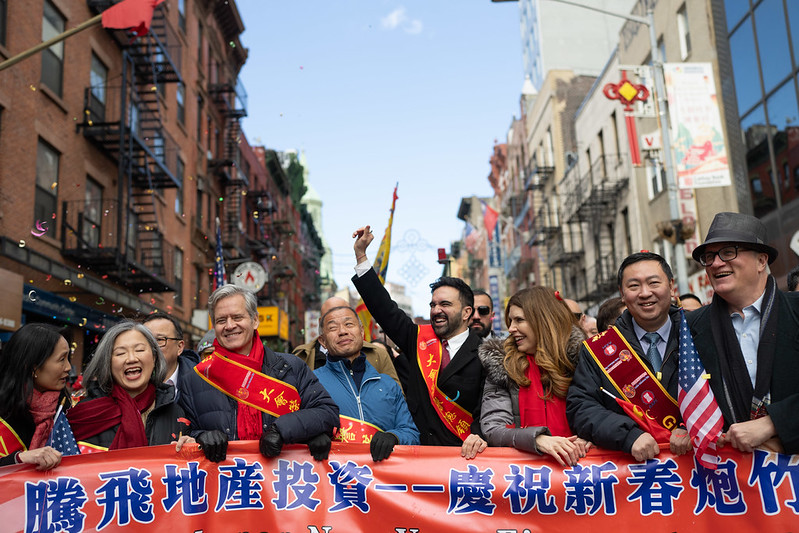
Mayor Mamdani attends the New York City Lunar New Year Parade and Festival in Manhattan’s Chinatown. Michael Appleton/Mayoral Photography Office
Instead of a commute home on the subway, on the Bowery in Manhattan’s Chinatown and Main Street in Flushing, coach buses arrive to take loads of Asian New York City residents on a longer journey. An activity host greets them in their native tongues, ferrying them through casino halls decorated in red, a traditional color of good fortune in Chinese culture. They are in the Foxwoods and Resort World casinos in neighboring Connecticut and upstate New York, respectively, where the whole experience feels as though it is catered to them, perhaps enabling an addiction to gambling prevalent in the community, per The National Institutes of Health. And now, New York City will be building casinos in the heart of one of the city’s most prominent Asian American areas – Flushing, Queens – and Mayor Zohran Mamdani is not stopping it.
Before he moved into the mayoral office in Manhattan, Mamdani represented Queens as a state Assemblymember so he is familiar with the “World’s Borough’s” immense diversity but also its socioeconomic issues – roughly 20 percent of Flushing residents live in poverty.
While voters in most of Queens overwhelmingly supported him in the election, it is also the borough where Mamdani has already invited some disappointment. One of the most contentious issues this year has been the decision for New York City to approve the construction of three casinos. There was a moratorium on downstate casino development until a few years ago, and it was not until December 2025 that the state Gaming Commission approved three downstate casino licenses – the site in Flushing, one in South Ozone Park, and a Bally’s in the Bronx.
Mamdani has publicly stated that although he is hesitant to accept casinos, he would respect the wishes of the voters. However, that vote – on a constitutional amendment to allow as many as seven casino licenses statewide – took place back in 2013.
Opposing it outright would have been in line with Mamdani and the Democratic Socialists of America’s stance against billionaires. Steve Cohen, who already owns the Mets baseball team, is the one developing the $8 billion, 50-acre entertainment complex next to Citi Field, where the Mets play. In 2013 his hedge fund, SAC Capital Advisors, pleaded guilty to insider trading and securities fraud — but that has not stopped Cohen from spearheading this deal, and many worry what the complex will do to the surrounding community, its small businesses, and its working class residents.
To be clear, Mamdani has not come out in support of Cohen specifically, but he has not opposed the project that advocates are saying will harm working class Asian Americans in the area either. While the borough of Queens may have voted yes on the project twelve years ago, current nearby residents seem to feel differently.
On December 16th, nearly a thousand protesters filled the streets of Flushing, where one of the casinos would be built. More than half of Flushing’s Asian voters oppose the project, according to the Asian American Legal Defense and Education Fund (AALDEF). Many feel that a vote that took place 12 years ago is not reflective of the current residents’ economic situation. Although the project has divided people in Queens, Flushing itself is majority Asian American.
Fulton Hou, a Flushing native, called Mamdani’s response of leaving it up to a vote that took place more than a decade ago “lukewarm,” but consistent throughout his mayoral campaign. He knows the mayor supports affordability and public health in Queens but Mamdani is also not actively commenting on the casino construction and what that could do for both keeping Flushing affordable and helping the community combat a gambling addiction crisis. The Mayor’s office has not responded to a request for comment on the matter.
Hou does not anticipate the Mayor’s position on the casino construction changing now that he has been in office for a few months, but he and fellow activists opposed to the casino have continued to organize, putting pressure on the politicians who pushed for its approval and Governor Kathy Hochul, who oversees the New York State Gaming Commission.
The role of politicians
The sharpest point of tension may be the casino’s economic promise. Flushing felt the sting of the post-pandemic economic downturn with the rest of New York. But before 2020, it was already the second-fastest developing neighborhood in the city, and rent had skyrocketed. “I think that Flushing has always been considered an ‘afterthought’ in the traditional electoral politics,” Hou said.
Once a quiet, steadily-growing Asian suburb, the New York City neighborhood has sprouted a staggering number of new luxury residential and commercial buildings in the last 20 years. Beneath the towers, however, Flushing’s longtime residents are slowly feeling the squeeze of visitors. Filled with bright chains from East Asia, including Daiso and Teso, Flushing is a booming commercial district, but its local businesses are struggling to pay rent.
“The cost of living is a huge part of our current hardship,” said a worker at Jangtur, a Korean restaurant in Flushing, who wished to remain unnamed. In recent years, she added, their worries have been exacerbated by federal immigration policy, which has made many community members scared to find new work, further squeezing local businesses’ workforce. “A good situation would be one where we benefit from better wages and costs,” she said, echoing the fear of many in the community opposed to the casino and what it might mean in terms of hurting revenue for local businesses.
Globetrotting visitors crowd the subway’s 7 line, their ride to Citi Field— the home of the New York Mets of Major League Baseball— and the US Open. This is the plot of land where hedge fund manager and New York Mets owner Steve Cohen has designs to build Metropolitan Park. The project’s official site and text blasts promise much-needed affordable housing, steady jobs that would prioritize hiring Queens residents, public green space and entertainment. “Entertainment” in this case means a casino.
After a series of town halls in 2024, State Senator Jessica Ramos (D-13th district) refused to introduce legislation to alienate the parkland for Metropolitan Park. Ramos, who represents a swath of nearby neighborhoods like Jackson Heights, cited her constituents’ financial hardship and need for green space. “We disagree on the premise that we have to accept a casino in our backyard as the trade-off,” Ramos said in a statement. “I resent the conditions and the generations of neglect that have made many of us so desperate that we would be willing to settle.”
Ramos drafted an alternative alienation bill that would allow Cohen to carry on with his plan, one without the casino but double the green space. “I don’t need to fight it [alone] anymore,” Jack Hu, lead organizer against the casino, recalled thinking. He thought that was the end of it.
Enter State Senator John Liu (D-16th district), who introduced his own bill to push the casino forward.
The first Asian American New York City Council member, Liu has consistently run on the promise of giving Asian Americans representation since the early 2000s. After all, Flushing is a famous ethnic enclave, whose residents are predominantly of Chinese and Korean descent.
Liu had initially opposed the casino, calling it “predatory.” However, Hou said Liu became a staunch supporter after a private meeting with Cohen. Liu also unveiled a plan to build a bridge connecting Flushing’s downtown to the proposed Metropolitan Park site across the river after that meeting. This facsimile of Manhattan’s High Line—- an elevated park built on an abandoned railroad track— would finally connect downtown Flushing to its waterfront area, which Liu said can currently only be accessed through highway overpasses that are not pedestrian-friendly.
On June 18 of last year, Liu and Council Member Chi Ossé (D-36th district) appeared side-by-side in an Instagram video officially endorsing Mamdani. “He understands that New York City belongs to us, not to billionaire donors,” Liu said in Mandarin. However, the reality is different for community members opposed to Cohen’s casino.
“It’s always jarring to rewatch any content from Senator John Liu claiming to represent Asian New Yorkers after he betrayed our community…to single-handedly revive a dead casino proposal that he himself says disproportionately harms Asians,” Hu said.
Several months into Mamdani’s administration, Hu said he felt Mamdani had yet to deliver on his campaign promise to protect working people. “It took just a month into his term to capitulate and endorse a politically vulnerable Governor Hochul,” Hu added, emphasizing the governor’s role overseeing the New York State Gaming Commission, and its approval of the casino construction.
Why Asians?
The high rate of gambling among Asian Americans is well-documented. After a tense town hall in February 2024, another question arose: Is this just a stereotype, or rooted in truth? The answer, instead, lies in why the casino is strategically placed between neighborhoods known to be home to working-class immigrant families.
For as long as Flushing has been majority Asian American, coach buses have carried locals to Foxwoods and Mohegan Sun, casinos in Connecticut. While growing up in Flushing, Hu remembers a “chaotic household” where he spent entire days at Foxwoods because of his father’s addiction.
“It is easy to see how the myth of the Asian gambler arose in the first place and then, perhaps through popular media, has been cemented,” Yi-Ling Tan, a program manager at New York University Langone Health, told Epicenter, a community newsletter based in Queens. Throughout history, Asian communities in the United States have turned to gambling when times were hard, hoping to win some money. Stressed and short on accessible entertainment venues, Tan said, low-wage workers are still the most susceptible to casinos—the modern-day gambling den.
The misconception that Asian Americans’ gambling addiction is rooted in culture is pushed by the media—and casino marketing teams. As Ben Hires, CEO of of the Boston Chinatown Neighborhood Center, told community news outlet Epicenter about the issue of gambling and Asian Americans: “What is juxtaposed is partly the sinister targeted marketing that casinos initiate, as well as their savvy understanding that with this particular group of people, there’s an opportunity to engage them into the casino.”
He noted that for some older Asian Americans in New York, it may not be an addiction or may not have started as such. We have seen for years that the bus loads of people from Chinatown are also making the casino trip to make ends meet by collecting and reselling vouchers to use in slot machines just for the cash.
In a statement sent to The Polis Project, a Metropolitan Park spokesperson said that “over 1,000 stakeholder meetings, and nearly 45,000 doors [were] knocked” as part of the effort to engage with the community. In a poll conducted by Schoen Cooperman Research, 62 percent of the surrounding neighborhoods directly supported the casino. The report specified that the surveys were conducted in English and Spanish, which are widely spoken in areas including Corona and Jackson Heights. But in Flushing, where residents tend to speak various forms of Chinese, Hu said: “We’ve canvassed probably thousands of residents. The vast majority of residents in our district do not even know about this casino.”
Services and larger NYC
According to the Coalition for Asian American Children and Families (CACF), one out of five Asian American Pacific Islander (AAPI) residents in New York City lives in poverty,
The issue is often “shrouded by the harmful myth of the model minority” when AAPI poverty rates are as high as any other minority group’s, according to CACF Co-Executive Directors Anita Gundanna and Vanessa Leung. The poverty rate is one of the highest in the city, a situation exacerbated by the COVID-era spike in anti-Asian hate crimes and recent cuts to federal assistance programs. The AAPI population is growing, and while Flushing is predominantly Chinese and Korean, its neighbors in Ramos’ district are defined by diasporas from across Asia.
“New York City must invest in the AAPI-led and -serving community-based organizations so many of our vulnerable community members turn to,” Gundanna and Leung said.
CACF holds no official position on Metropolitan Park. But, the casino reveals the dearth of accessible services that could support these communities. Be it education, mental health clinics or youth programming, the options are few and language interpretation services are not always sufficient. During the 2022 fiscal year, AAPI organizations—many of which covered these areas—only received 4.66% of the City Council’s discretionary funds that could be used to support in-language and culturally competent support.
Casinos are a mixed bag when it comes to jobs and the local economy
Aside from entertainment, supporters of the casino said that the project will create job opportunities. At town halls, some of the loudest supporters of Metropolitan Park are workers’ unions. After Liu’s announcement, several unions called to support his bill, looking forward to steady employment while constructing Metropolitan Park, as well as the maintenance and customer service jobs once the casino is open.
Resorts World Catskills in upstate New York reportedly boosted the local economy so significantly, its employees have expressed concerns over competition from the new casinos in the city.
Supporters of Metropolitan Park expressed hopes for similar fortune, including Eddie Valentin, the owner of Friend’s Tavern, one of the businesses that make up Jackson Heights’ vibrant LGBTQ nightlife. At a New York City Council public hearing, Valentin recounted the overwhelming number of applications he would receive when hiring. “Many applicants tell me they wanna be close to Queens because they have children in school or they take care of their elderly parents,” he said. “It’s sad to see how many excellent candidates I cannot give a job to.”
The hope, Valentin concluded, is the creation of 23,000 construction-phase union jobs and 6,000 permanent union jobs. Flushing and its neighbors have been creaking under the weight of economic neglect and gentrification for some time; as far as he and multiple local stakeholders are concerned, the project is throwing them a lifeline. However, at the moment this is just a projection regarding the number of jobs.
On the flip side, a report by Luke J. Schray, now Vice President at New York City Housing Development Corporation, called casinos “insular entities that do not impact outside their own footprint.” The project promises increased tourism dollars and local spending, but the area is already home to Citi Field, where tens of thousands have flocked to see the concerts and Mets games. Flushing’s local businesses, already competing against international chains amid rising rents, worry that a casino would be the final nail in the coffin.
“Every job gained from the casino is a job lost from other businesses in the surrounding community,” Hu said.
But through their fight, Hou and Hu have seen a growing movement – even without Mayor Mamdani’s opposition to the casino construction or support for small businesses in Flushing.
The neighborhood lacks the history of activism that built Manhattan’s Chinatown because until now, Hu said, people like him have not stepped up. Hou likened people’s perception of the neighborhood to drinking the Kool-Aid—being lulled by the glitzy, trendy new businesses without considering the consequences. “We’re drinking so much Heytea and Molly Tea that we’re just in it for the Chinese cultural aesthetics,” he said, referring to the international bubble tea chains that opened in Flushing, “but we’re not actually willing to engage in the political education.”
After years of attending community board meetings, Hu said: “We’re done chasing this dog and pony show. We have to build political power.”
How Mamdani, City Council, and the Gaming Commission will respond to this will be a test for his commitment to making the city affordable, which many contend adding casinos to lower income areas and communities negatively impacted by gambling will not do.
We like bringing the stories that don’t get told to you. For that, we need your support. However small, we would appreciate it.
This is not a paywall.