
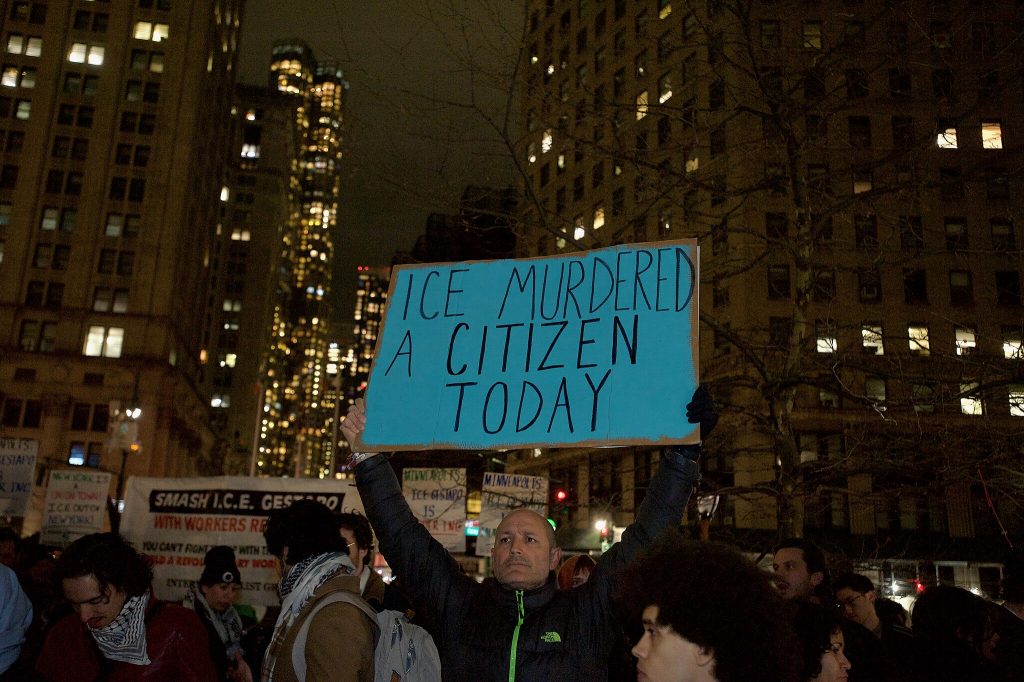
Protesters at Foley Square protesting the ICE killing of Renee Good. Photo by SWinxy, CC BY 4.0 (Wikimedia Commons)
Mayor Zohran Mamdani announced a new executive order on Feb. 6 reaffirming and clarifying the city’s protections for its immigrant residents. “Across this country, day after day, we bear witness to cruelty that staggers the conscience,” Mamdani said at a gathering of faith leaders, referencing the recent shootings of Renee Good and Alex Pretti by federal agents in Minneapolis. “Masked agents, paid by our own tax dollars, violate the Constitution and visit terror upon our neighbors.”
Among the executive order’s provisions: a bar on federal agents entering city property without a judicial warrant; orders for city agencies to protect all private information of New Yorkers; and the announcement of an audit to make sure that city agencies are complying with existing “sanctuary city” laws.
Sanctuary policies do not prevent immigration agents from stopping, arresting, or deporting anyone, but they prohibit city resources from being used for that enforcement. New York City’s sanctuary laws are among the strongest in the country, but not immune to cracks—or the political whims of local leaders. Former Mayor Eric Adams, for example, wanted to allow immigration agents to post up at Rikers Island despite these protections, a move that a judge later ruled was illegal—and, on his last day in office, vetoed legislation passed by the City Council that would have strengthened the ban on immigration authorities at city jails. City Council recently overrode that veto and passed it again.
Human rights groups have long criticized the tactics used by federal immigration agents to round up and deport immigrants, but under the current administration, the behavior of these agents on the streets of U.S. cities has become much more violent, brazen, seemingly indiscriminate—and therefore, more visible.
The killing of Good and Pretti—both white Americans—marked a turning point in public sentiment: Over 60% of the nation now believes immigration enforcement under the current administration has “gone too far,” according to a New York Times poll. A separate YouGov poll finds that a plurality of Americans now support abolishing Immigration and Customs Enforcement (ICE), the Department Homeland Security (DHS) agency that arrests, detains, and deports people from the U.S..
ICE has borne the brunt of the public backlash, even though in the case of both Pretti and Good, it was Border Patrol agents— who are part of the U.S. Customs and Border Protection agency— who did the shooting. Part of the reason is because during the second Trump administration, ICE and Border Patrol have blurred together into the hyper-militarized, masked forces on the streets of American cities today.
ICE has been stretching its power to enter private property through internal directives and detaining record numbers of people. The Border Patrol—which has historically enjoyed extended search and seizure abilities within a massive zone that extends 100 air miles inland from any external boundary of the continental U.S. border and Alaska —has expanded its reach further and further inside the country.
Case in point: When Trump’s “border czar” Tom Homan announced a slight drawdown of the federal agents in Minneapolis, which is more than 250 miles from the U.S. border with Canada, on Feb. 4, he noted that 2,000-plus remaining ICE and Border Patrol personnel would answer to a “unified chain of command.”
Mamdani recently joined the chorus of critical voices, saying on “The View” that he favored abolishing ICE: “We’re seeing a government agency that is supposed to be enforcing some kind of immigration law, but instead what it’s doing is terrorizing people no matter their immigration status,” he said to a round of applause.
Though immigration policy and enforcement are under the purview of the federal government, the mayor, City Council, the state legislature, and the governor can do more to shore up the city’s defenses, advocates say. Mamdani’s February executive order was one move in that direction.
“It’s not hard for our elected leaders in New York at the city and state levels to point their fingers at ICE and say, ‘This is unacceptable,’ and, ‘This is horrifying,’ and they’re right,” said Yasmine Farhang, the executive director of the Immigrant Defense Project. “But we are pointing our fingers at our local leaders… and we’re saying, ‘What your responsibility is, is to make sure that the city and state are not enabling this further.”
Prepare for, and Prevent a Blitz
On Dec. 10, Mamdani said he was “prepared for any consequence” that came with pushing back against federal immigration enforcement.
Shortly after his inauguration, Mamdani also met with President Donald Trump. Trump was all smiles, shrugged off that Mamdani once called him a “despot,” and said that he would be “cheering” for the new mayor – a reception that was unexpected but very cautiously welcomed by New Yorkers. Mamdani’s charm offensive, whether intentional or organic, may have been in the best interests of the city, at least in the short term. While Mamdani was likely not the only reason Trump de-prioritized New York for a Chicago- or Minneapolis-style surge, he also has a history and financial interests in the city. Mamdani was able to “leverage a positive individual relationship with Trump into a more sort of protected situation,” said Daniel Stageman, director of research at the John Jay College of Criminal Justice at the City University of New York, who has long tracked local-federal immigration partnerships.
Of course, there is no telling if, or when, that reality might change. And, even if Trump has not ordered a targeted operation in New York City, enforcement has risen and ICE has opened a large facility about 50 miles north of the five boroughs. Data compiled by news site Documented show that ICE arrests have risen by 212% between the last six months of President Joe Biden’s term and the first six months of Trump’s second term beginning in January 2025. In December, local community members, organizers, and activists thwarted an ICE raid on Canal Street in Manhattan. The following week, the incoming mayor released a “know-your-rights” video targeted at immigrants and business owners. Now he has gone further: In his executive order, he expands the city’s know-your-rights campaign and creates an inter-agency committee to coordinate to prepare for, and respond, to a “crisis,” should it come to town.
Strengthen and Clarify Sanctuary Laws
Following the meeting with Trump last month, the mayor’s chief of staff said that he had “made clear [to the President] that we uphold sanctuary laws in our city.”
New York’s first such policy was put in place by Mayor Ed Koch in 1989 via executive order and protections were expanded through laws passed in 2011 and 2014 by the City Council. City agencies are barred from sharing information about immigrants in their custody, or holding them for extra time in jails for federal agents to come and pick them up.
Current exceptions to these laws include if the agents have a judicial warrant signed by a judge, if the immigrant in question has been convicted of a serious, violent crime, or is on a federal ‘terror watch list.’ On the campaign trail, Mamdani promised he would strengthen existing sanctuary laws—and review if the city shares the personal data of its residents with federal agencies. On February 6, the Mayor signed an executive order requiring city government agencies to have a privacy officer who will be in charge of safeguarding immigrants’ personal identifying information.
City watchdogs have indeed found instances in recent years where NYPD and jail officials have “violated our law on a number of occasions, in some ways that are one-offs, and other ways that are more systemic…and there’s no existing mechanism to hold city agencies accountable when they infringe on the rights of immigrant New Yorkers” by sharing information about them to federal agencies, Farhang explained.
Mamdani’s new executive order adds an audit and some oversight mechanisms, but many immigrants rights’ groups are pushing for other local legislation that would further strengthen the city’s sanctuary policies by, among other things, narrowing the exemptions to the existing laws and bringing them in line with New York’s state laws, which go slightly further in certain ways.
Address the Ways Around the Firewall
The way the system is currently set up, local police can circumvent existing sanctuary laws by entering into collaborative agreements with federal law enforcement. They can set up joint task forces that are meant to tackle possible crimes that, at least on paper, do not primarily relate to immigration.
“We know that joint task forces are often used pretextually as a way to get around our laws,” Farhang said, concerned about the lack of transparency regarding the objectives and tactics these joint task forces use.. The Mamdani administration could ensure that there is a “clear and formal policy” about when and how these joint task forces operate and that until then, all cooperative agreements are suspended until there is an oversight investigation of existing task forces. “So we need kind of like a bright line policy,” she said. Observers have noted that Mamdani may be working to establish that with the NYPD or Department of Corrections as he also navigates non-immigration related law enforcement policies.
“The previous divisions within ICE that were relatively firm lines? Those no longer exist,” Stageman said. These multiagency collaborations generally involve the branch of ICE – Homeland Security Investigations (HSI) – that historically focused on transnational trafficking and drug cartels instead of civil immigration infractions. But in the second Trump term, the internal boundaries within ICE have also blurred as agents from this department have been tasked with routine street enforcement. Other federal agencies, including the FBI, U.S. Marshals Service, Drug Enforcement Agency (DEA), and the Bureau of Alcohol, Tobacco, Firearms (ATF) have also been redeployed towards the mass deportation-related tasks.
National security and anti-immigration views have long been conflated in the U.S., but particularly so since September 11th in New York City. Trump has used his skill in marketing to play heavily on that xenophobia in his second term., He released a memo in September 2025 that creates a broad dragnet for so-called dissidents— anyone the government deems to espouse “anti-Americanism” and “extremism on migration.” The memo directs the Joint Terrorism Task Forces (JTTF), in which ICE plays a critical role, to “coordinate and supervise a national strategy to investigate, prosecute, and disrupt entities and individuals engaged in acts of political violence or obstruct the rule of law.”
The first JTTF was established in New York and includes state and local law enforcement coordination, a tactic the New York Civil Liberties Union has long criticized. “Given this environment and the Trump administration’s insatiable desire for sensitive state and local information, there has never been a more important time for New York to sever ties with these law enforcement entities,” wrote Daniel Schwarz and Simon McCormack of NYCLU.
Several cities have pulled out of their anti-terrorism task force in the last few years. Most comparable to New York City’s situation would be what San Francisco did in 2019, when SFPD left a joint federal task force over concerns about federal officials not following its local rules on the use of force and body cameras.
Work with the Governor, State Legislature on Consistent Policies
Gov. Kathy Hochul recently announced a package of laws that would, among other things, ban a type of federal-local agreement called 287(g), which allows ICE to deputize local and state police as immigration agents. It would also prohibit separate agreements that allow ICE to use local and state jails for immigrant detention. Shayna Kessler of the Vera Institute of Justice told the Polis Project this move “a solid step in the right direction” but added that “it does not go far enough in terms of what the state can do.”
She and other advocates instead back the New York for All Act at the state level, which they say provides the “more comprehensive framework we need.” This legislation would prevent not just law enforcement, but other state and local institutions, including public hospitals and schools, from asking about and sharing information with ICE.
The state-level law is out of Mamdani’s jurisdiction, but as an influential voice as the mayor of the largest voting bloc in state and key endorser for Hochul’s reelection bid, he has gotten her buy-in on some of his other policy objectives, giving promise for policies concerning ICE raids. “Anything he can do to assert that the city’s resources and the state’s resources should not be used to fuel or support this anti-immigrant agenda,” would go a long way, Kessler said.
Overhaul the Policing Culture
The stickiest issue is changing some of prevailing culture and policing practices at the NYPD, the primary local bridge to ICE. “Part of what we need is policing change for all New Yorkers, immigrants or citizens,” Farhang said.
As mayor, Mamdani oversees this law enforcement agency with a massive budget, wide footprint, and a behemoth and storied surveillance apparatus. Anyone who gets booked into jail and fingerprinted appears on ICE’s radar, even if no charges are ever filed, because the federal agents share access to national crime databases with local law enforcement.
There is also “a culture of collusion…that is much much harder to document because it’s really about the kinds of informal ways that members of NYPD [are] complicit” with ICE,” Farhang explained. We already know about emails showing friendly and informal communication between jail officers in the city and ICE, in which they appeared to coordinate the deportations of people in their custody. In 2024, following a viral video of a clash between new migrants and police in Times Square, the police and ICE also collaborated to deport immigrants who were at the fringes of the incident, according to the account of a targeted immigrant.
Mamdani has expressed wanting to redefine the role of policing, from a catch-all response to society’s problems to one that is siloed to tackling actual crimes. The City Council just introduced a bill to create his proposed civilian-led department for community safety. The department would complement policing by prioritizing mental health and social workers as first responders for specific types of crises and homeless outreach. He has also said he would end “broken windows”-style policing, the theory that policing street-level petty, quality-of-life crimes like loitering, public drinking, fare evasion, and vandalism prevents more serious crime. However, this theory has also long been criticized by community activist groups for being racially discriminatory.
Mamdani has also suggested that he would discontinue the city’s problematic gang database, which has been inaccurate in the past, assembled using very loose criteria, critics say, and accessible to ICE. The new mayor has also vowed to disband the specialized squad that was created to go after terrorists or mass shooters, but which in reality acted like protest police. All of this would help strangle what rights groups call the “jail-to-deportation pipeline.”
At the same time, Mamdani’s retention of Jessica Tisch as NYPD commissioner has generated some concern. Advocacy groups and policing critics worry the move signals more of the status quo since Tisch is a holdover from the Adams administration and a proponent of some of the policing tactics and surveillance technologies Mamdani opposes. Mamdani told Hell Gate last October that he set the tone for the department as Tisch’s boss, but a cultural change within the NYPD is unlikely to happen by the flip of a switch, or the change of a mayor. Mamdani will have to strategically navigate the internal politics and external optics of trying to usher in such change, in particular, of removing someone like Tisch—a white, Jewish heiress to a billionaire fortune whose influential family has a long history of business, philanthropy, significant political contributions, and gifts to the New York City Police Foundation.
In the meantime, advocates want the City Council to pass legislation like the NYC Trust Act, which mirrors one of the legislations in Hochul’s package and would give anyone wrongly harmed by collusion between local and federal authorities the right to sue. Farhang and the coalition of advocates “look forward” to working closely with the newly-formed interagency committee and the Mamdani administration “towards true accountability and action,” Farhang says.
We like bringing the stories that don’t get told to you. For that, we need your support. However small, we would appreciate it.
This is not a paywall.