
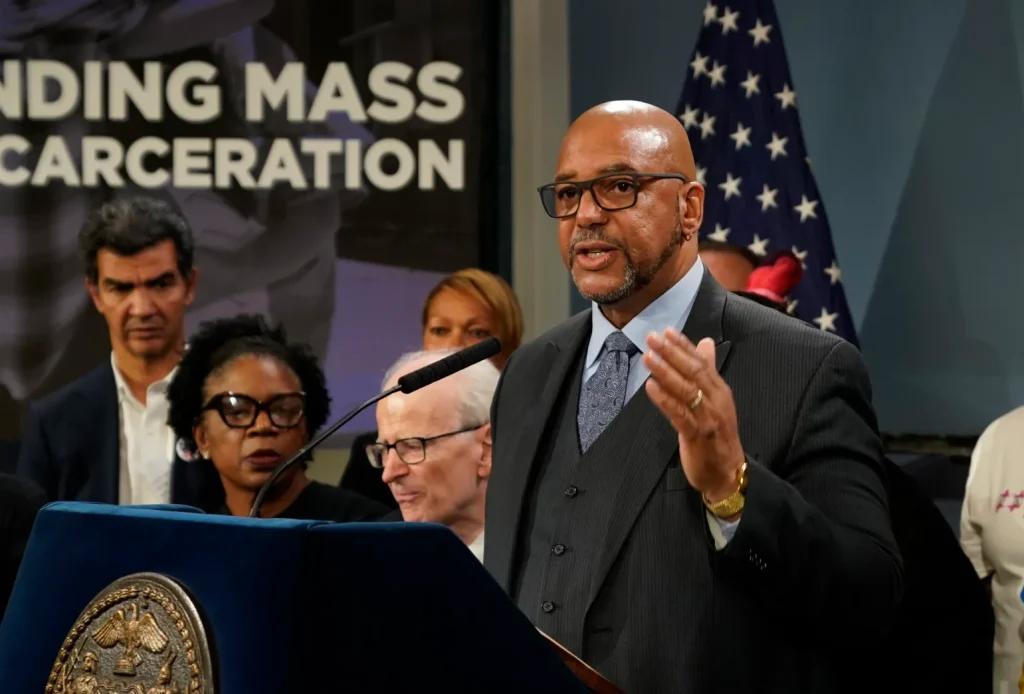
On January 31, Mayor Mamdani announced the appointment of Stanley Richards as commissioner of the New York City Department of Correction. The historic selection makes Richards the first formerly incarcerated person to hold the role. Following a federal investigation that found a “deep-seated culture of violence” and excessive use of force, a court-appointed remediation manager will oversee reforms at Rikers Island. At the same time, the city faces a City Council mandate to close Rikers and transition to four smaller borough-based jails. Richards is set to assume the role on February 16, 2026.
The Polis Project’s Shaan Merchant spoke with Richards about his plans for the Department.
This conversation has been edited for clarity and length.
Shaan Merchant: Commissioner Richards, thank you so much for your time, and congratulations on this historic appointment. How does your perspective as the first formerly incarcerated Commissioner for this department shape how you approach this job?
Stanley Richards: My personal and professional experience have taught me one thing: as a nation, as a city, and as our mayor has said, we need to value everybody. And so I start this work by saying to the officers, I see you, I hear you, I value you. My job is to ensure safety and that you’re equipped with the skills and tools necessary to do your job. To the incarcerated people: your story is not over. While you’re in our care, we will bring every resource necessary to help you build a new life for yourself and your family. While you’re here, you will be safe. We are not the judge and jury. While you’re here, your family will have access to you. When you center your work on the humanity of those who interact with whatever system, you can begin to then change the way people see each other, the way people interact, and the way that the system facilitates that interaction, and that’s the charge that I have.
SM: At The Fortune Society, you earned recognition as a Champion of Change from the Obama administration for your work with formerly incarcerated people re-entering their communities. Now that you’re on the other side, why does that experience matter?
SR: In New York, we have an extensive network of community-based providers ready to partner with the department to help people build a different life. My role as president and CEO of the Fortune Society, is about making sure people have resources and support so they can change their life. When they do that, we have public safety. So I’m going to engage the network of providers in the work that the department is doing, and we’re going to do it in partnership, so that people, while they’re in our custody, can get access to those services, get connected immediately upon release, and have a different future.
I’m also going to be working with the Alternatives to Incarceration programs [to] safely reduce the population by ensuring those who are eligible…have access to that resource immediately. As Commissioner, I will use my 6-A [work release program] authority to look at every city-sentenced person to see if they’re eligible for 6-A consideration.
I’m going to work with my counterpart, Commissioner [Daniel] Martuscello, in the state, to ensure that anybody who is sentenced and ready for transportation to the state system is taken expeditiously. I’m going to work with the district attorneys and the courts to make sure that cases get processed faster.
We cannot and should not have over 500 people in our jails for over two years. We should not have over 50% of the people in our jails with mental illness. So I am proud to work for Mayor Mamdani and to know that his approach to these entrenched problems will require all of the government. I love that approach, and we’re going to need it.
SM: Right, and with that perspective, working in nonprofits on the outside, you’ve seen how slow government and bureaucracy can be. How do you plan on bringing swift progress? What is something you hope New Yorkers will feel in six months rather than an impact years from now?
SR: I think the government moves at the pace of the leadership. And we have a mayor who is not accepting the status quo. We are in a new era, and it’s a new era of government work…It’s a new era about how we leverage every resource of the city to address some of the entrenched problems that New Yorkers face. As the mayor said, every New Yorker deserves to live in dignity, every New Yorker deserves to be heard and included, and every New Yorker deserves to be valued.
SM: Rikers will be a major point of consideration throughout your time. In 2025, 15 inmates died while incarcerated at Rikers. What are the immediate steps that you’re looking to take for the safety of the incarcerated population there?
SR: Safety for everybody. I think the way we get safety is going back to the basic correctional practices: making sure that we are bringing in programs so people don’t sit around idle, that they’re engaged, making sure that we have enough officers to be able to man the very outdated and dilapidated facilities that we have, making sure that officers are trained to deal with today’s population, the majority of whom are people with mental illness, making sure that we are providing the care for our officers and wellness for our officers, and making sure that we prioritize the safety of incarcerated people and the safety of officers. This is not a speed boat moment. This is a battleship moment. It’s going to take us all working in the same direction, and that’s the team I’m building out together that will be in my administration, that every single day we will be making sure that no officer gets hurt, no incarcerated person gets hurt, that there’s no loss of life.
SM: And how do you balance the immediate need for safety and improvement with this looming deadline of an August 2027 closure of the facility?
SR: As the Lippman Report [by the Independent Rikers Commission that helped inform the plan to close Rikers] noted, we have to make incremental progress on the fronts that will allow us to close Rikers. We need to use every government lever to make sure that we’re expediting the borough-based jails. We need to do everything we can to begin to reduce the population. Reducing the population prepares us for closing Rikers and moving to a borough-based jail. Reducing the population also allows our officers to operate in a much more manageable way.…
We then need to look at our training to ensure it is up to date and adequate for the population we have…Our officers aren’t clinicians, social workers, or therapists, so we need to work on that. And I think by doing those things, we will be demonstrating to New York City, to the City Council, that this administration is serious about closing Rikers and building borough-based jails, so that for those who have to be detained, they will be detained in a humane facility. And for those who work in those facilities, they will be working in facilities that are centered on their humanity, and that gives them the tools to safely manage the population that we have.
SM: There’s been some backlash around the borough-based jail locations, particularly in Chinatown, with some feeling like these facilities are going to be harmful to the community. How do you respond to those concerns?
SR: When I was President and CEO of Fortune, I was on the Lippman Commission. We have engaged the community, and we’ve been listening. What we try to do in each of the borough-based facilities is to build out a community space so communities have access to some of the resources that could be in that space. I think it’s an ongoing dialog, not a dialog to change direction on the borough-based jails, but a dialog to hear their concerns…and to address those underlying concerns
The borough-based jails are aligned with the courts’ [locations], so the department can reduce transportation. Families don’t have to travel all the way out to Rikers to visit their loved ones; they can visit their loved ones in the borough where they live, and they can have access to resources when they come to visit or when someone is released. It’s ongoing listening and dialog.
SM: Are you looking into any alternate sites, especially with that Chinatown location?
SR: I have not been briefed on where the borough-based jails are. From what I understand, the locations we have are the ones they’re building at. I don’t think the city is looking at alternative sites.
SM: You’re working under federal oversight, too, with [federally-appointed Rikers Remediation Manager] Nicholas Deml. Have you spoken with him, and how do you plan on navigating that relationship?
SR: Yes, we had a really good conversation a couple of days ago. I’m really excited to get to work with him. He and I both see our work in partnership…His goal is to address the 18 contempt orders…that generated the Nunez Decree [the federal consent decree mandating reform after the Nunez vs. New York City class-action lawsuit on systemic violence, excessive use of force, and misconduct]. My job is to address safety. So we’re going to work together. My office will be on Rikers. He will have an office on Rikers. We will be in constant communication and working together because, at the end of the day, I want to make sure…our officers are safe. I want to make sure incarcerated people are safe, and that for whatever time someone is in our care, they have access to resources to build a different life.
SM: Some of your reform-based ideas might clash with COBA [the powerful corrections officer’s union]. What does earning trust from that staff look like for you?
SR: With any reform and change, I want COBA at the table. At the very beginning, we’re going to have conversations about what I’m thinking. I want to hear their ideas about what we could be doing, because, like the Remediation Manager, what COBA is asking for is what I want. I want officers to be safe. I don’t want violence in our jails. I don’t want officers to get hurt…So I am going to work every day in partnership with the Remediation Manager, in partnership with the union to make sure that we deliver. My framing is that a rising tide lifts all boats, right? And we need to rise the tide together.
SM: Lastly, you bring so many perspectives to this work: as a formerly incarcerated person, as a leader at The Fortune Society, and with experience in government. What’s something you understand about correctional leadership today that we didn’t even think was possible years ago? What does this new leaf look like?
SR: Well, it’s the leadership that I’ve always demonstrated, leadership centered on hope, leadership of inclusion, leadership that values the contributions of those around you, leadership that is clear-eyed on the goal, leadership that is clear-eyed on accountability, and leadership that delivers results. That’s what we have right now with me, with Mayor Mamdani, and with this administration, and we will deliver for New York.
We like bringing the stories that don’t get told to you. For that, we need your support. However small, we would appreciate it.
This is not a paywall.