
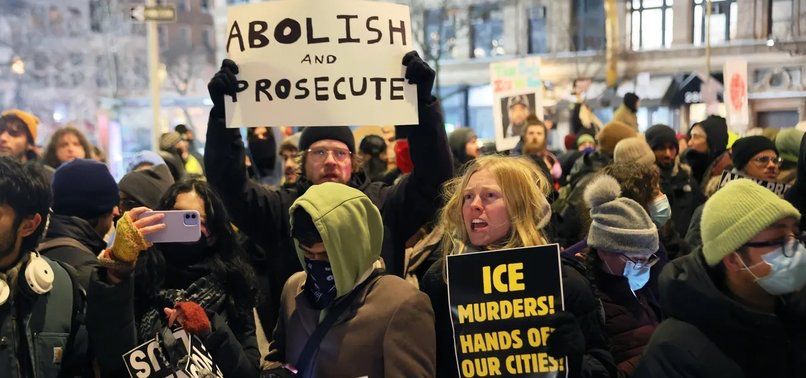
Mayor Zohran Mamdani has reiterated his campaign pledge to dissolve the NYPD’s Strategic Response Group (SRG) while calling for a separation between its counterterrorism operations and protest policing, at a press conference on Wednesday, January 28. According to Mamdani, the separation is essential to protect First Amendment rights amid rising tensions over ICE raids and detentions in the city. He revealed ongoing conversations with Police Commissioner Jessica Tisch on operationalizing the change. However, Mamdani has not presented a timeline for SRG’s disbandment, and the SRG will continue to be deployed to protests for now.
This comes hours after the SRG’s latest deployment: on January 27, over 100 anti-ICE protesters occupied the Tribeca Hilton Garden Inn lobby, alleging that it housed the federal agents; over 60 people were arrested on trespassing summonses after refusing to disperse, marking the first mass arrests under Mamdani’s watch. Mamdani commended the demonstrators, labeling ICE a “rogue agency” while doubling down on ending the SRG’s role in protests.
Mamdani has been publicly critical of the SRG since 2024, vowing to disband it over its millions in lawsuit settlements and brutalizing countless New Yorkers exercising their First Amendment rights. On Wednesday, he outlined plans to decouple counterterrorism responsibilities from police responses to First Amendment activities, thereby insulating protests from a militarized response. In the past, critics, like public defenders (the Association of Legal Advocates and Attorneys), have urged firing Tisch, given her defense of the SRG during the 2024 Columbia operations that targeted student protesters.
“The mayor is right to reiterate his commitment to disbanding the SRG, and we will be watching closely to ensure that this pledge becomes a reality,” said Michael Sisitzky, assistant policy director at the NYCLU. “The SRG was a mistake from its very inception, as its history of misconduct and track record of violent and militarized suppression of protest activity makes clear. It is incumbent on Commissioner Tisch to work with Mayor Mamdani to deliver on his promise. And it is incumbent on the City Council to pass the CURB Act to codify protections against the SRG’s worst tactics into law.”
The CURB Act (Communities United to Reject Brutality)—NYCLU-backed legislation to statutorily ban SRG’s most abusive protest tactics like indiscriminate kettling and mass arrests—was first introduced by Councilmember Chi Ossé in March 2025, reintroduced at the January 23 Stated Meeting, but remains stalled in the Public Safety Committee with no hearings scheduled.
The SRG’s Role in NYPD, History of Aggressive Protest Suppression and Brutality
Launched in 2015 under the NYPD’s Special Operations Bureau, the SRG comprises around 800 highly trained officers organized into five borough-based teams—Bronx, Brooklyn North, Brooklyn South, Manhattan, and Queens/Staten Island—plus a dedicated Crowd Management Unit. According to the ACLU, the SRG budget expanded dramatically, rising from an initial $13 million to $133 million. This growth occurred despite substantial overlap in responsibilities, as virtually all SRG policing functions are already handled by other NYPD units.
Initially tasked with counterterrorism, active shooter responses, civil disorders, riots, and large-scale events like parades or mobilizations, the SRG quickly pivoted to aggressive protest suppression by late 2015. Its notable early actions included deploying Long Range Acoustic Devices (LRADs, or “sound cannons”) against Black Lives Matter demonstrators in December 2015.
The pattern escalated in 2018. Videos on the internet show the Proud Boys throwing punches, kicks, and homophobic slurs as the SRG officers watch without immediate intervention. As photojournalist Shay Horse criticized, “The SRG seemed entirely focused on the anti-fascists… By totally ignoring the Proud Boys, the police pretty much allowed them to assault people.” NYPD later pursued nine Proud Boys and three antifa on riot charges, but the initial response drew backlash for passivity toward far-right violence. The SRG unit also handled an anti-ICE deportation protest on November 29, 2025, near a Chinatown parking garage, resulting in 18 arrests.
Tactics like kettling (trapping crowds), wedge formations, and mass arrests earned SRG the “goon squad” label from activists and drew NYCLU lawsuits over racial bias, excessive force, and misconduct. Since its inception, SRG officers have faced hundreds of misconduct complaints and numerous civil lawsuits, including “more than 1,300 complaints and pieces of evidence” about the police response to the protests in New York City, and 13 million settlement for 1,380 arrestees, alongside 98 Bronx arrest notices and broader NYPD protest payouts exceeding $121 million annually by 2023 as part of over $500 million in misconduct settlements since 2018.
The SRG also spearheaded violent clearances at Columbia University’s Gaza solidarity protests: the 2024 Hamilton Hall occupation resulted in over 100 arrests, while the May 2025 Butler Library sit-in led to 78 arrests amid reports of beatings and chokings.
This blurred counterterrorism threat assessments with efforts to suppress dissent. The NYCLU echoed this collapse, noting that, “The NYPD once again deployed its Strategic Response Group to campus, a unit that has a history of escalation and violence.”
Reform Challenges
Disbanding SRG faces fierce union resistance from the Police Benevolent Association (PBA), the nation’s largest police union representing rank-and-file officers, which previously challenged and delayed the 2023 Payne v. De Blasio settlement through legal appeals, despite support from other unions like the Sergeants Benevolent Association (SBA) and Detectives’ Endowment Association (DEA).
The 2025 settlement in the class-action Payne v. de Blasio stemmed from the 2020 George Floyd protest abuses and imposed strict limits on the SRG through a four-tiered protest response system. This system bars the unit from responding to low-risk First Amendment events (Tier 1), restricts it to support roles in moderate scenarios (Tier 2), and mandates supervisor approval plus body cameras for higher escalations (Tiers 3-4).
It explicitly banned kettling without judicial warrants, required de-escalation training for all officers, prohibited the use of less-lethal munitions at Tier 3 or below, and established civilian oversight through the Civilian Complaint Review Board (CCRB), including real-time protest monitoring and post-event audits.
Despite these reforms—hailed by the NYCLU as a “landmark” but criticized as insufficient—a federal judge ordered compliance in October 2025 after NYPD violations. The SRG nonetheless led Columbia’s 2025 Butler Library raid (Tier 1 event) and continues tactical training, prompting contempt motions.
Police Commissioner Jessica Tisch’s position adds friction. Retained by Mamdani despite criticism, her family— tied to the billionaire Loews Corporation, and who have donated $1.3M to anti-Mamdani PACs— drew scrutiny after her brother Benjamin called Mamdani an “enemy of Jews”, prompting her apology.
Success now hinges on whether Mamdani’s talks with Tisch yield concrete policy, or dissolve into bureaucratic process, as activists test his pledge: “As Mayor, I will disband the SRG.”
We like bringing the stories that don’t get told to you. For that, we need your support. However small, we would appreciate it.
This is not a paywall.