
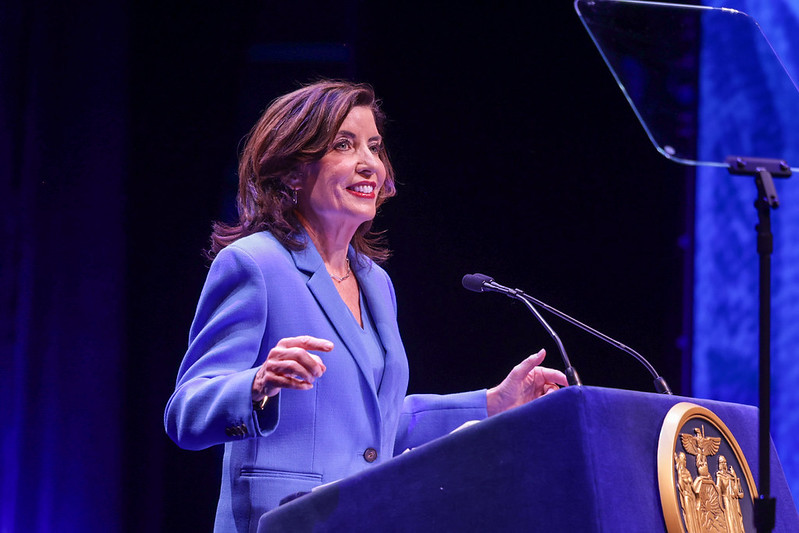
Right after Gov. Kathy Hochul sidestepped any talk of tax hikes in her annual address to the state, Mayor Zohran Mamdani doubled down on his position that raising taxes is essential to paying for his affordability agenda.
During the State of the State on Tuesday, Hochul laid out a breadth of policy priorities including free childcare, completing public transit projects like extending the Q train and expanding the 125th St station in Harlem, stricter laws to protect children from tech products like AI chatbots, easing barriers to building housing, lowering auto-insurance rates, and expanding the amount of nuclear energy the state produces. Yet, the state faces a potential budget deficit, as well as pressures from the Trump administration in the form of future federal funding cuts and ramped-up presence from Immigration and Customs Enforcement officers in the city.
With Hochul running for re-election this year, she is vying for votes from the progressive coalition that led Mamdani to a decisive win. And while her speech highlighted affordability, a key issue that Mamdani made the cornerstone of his campaign, it had no mention of any increases in taxes that she could use as additional revenue in the face of coming funding cuts from the federal government or to fund other affordability initiatives – like those Mamdani has proposed. In fact, Hochul stated that she plans to “make transformative investments in [New York’s] future. Without raising taxes.”
Wall Street has generated higher-than-expected tax revenue for the state this past year, and if that continues, Hochul can use that to offset some of the pain of the federal funding cuts so she is able to delay raising income taxes.
Hochul has previously said that she is not open to raising income taxes, but she has not completely ruled out changing the corporate tax rate. This puts her somewhat at odds with Mamdani’s position that taxing corporations and millionaires is crucial to funding key affordability priorities in the city. New York City relies on the state legislature and the governor to raise those taxes.
Mamdani’s direct authority over tax revenue is largely limited to property taxes, with the support of the City Council. The city will collect around $35 billion this year in property taxes, but any rate increases might mean owners of apartment buildings passing those costs on to renters, thus defeating the purpose of Mamdani’s affordability-first agenda. During his campaign, Mamdani proposed that he will push for a higher state corporate tax and a flat 2% increase on income tax for the top 1% of income earners – a strategy that may have to change based on how Albany votes and the results of 2026 midterm elections – to fund programs meant to help all New Yorkers, but especially those in lower income brackets.
“I’m calling on all of our partners in Albany to ensure that we can not only fund the city’s day-to-day operations at a continued scale, but also that we can fund our affordability agenda,” Mamdani said to reporters following Hochul’s speech. “I do believe that raising taxes on the wealthiest New Yorkers and the most profitable corporations continues to be a critical part of that.”
Rachael Fauss, the senior policy advisor at Reinvent Albany, a nonprofit watchdog organization focused on New York State government, told The Polis Project that the question of how the state raises funds for its existing operations and new programs will be a big one.
“It’s typical in that [Hochul’s State of the State is] promoting all the good ideas, but side-stepping the question of how to get there, when the how to get there sometimes involves taxes,” said Fauss. “New York is going to get hit pretty hard with federal cuts. They’re not hitting this year, but what’s the plan to deal with that in the future?”
Although the state is not currently facing a revenue shortfall, the Fiscal Policy Institute, a nonpartisan nonprofit think tank, has warned that the state’s Division of Budget may be underestimating the scale of federal funding cuts stemming from the Trump administration’s budget proposal. The organization predicts that the cuts will rise from $5.8 billion next year to $14.3 billion by 2030.
“The State should levy new revenue measures to maintain essential services cut by the Trump administration, including Medicaid, SNAP (colloquially known as food stamps), and the Essential Plan,” wrote the Fiscal Policy Institute in a statement following Hochul’s speech. The institute also urged the state to develop a public health insurance option and fund low-income assistance programs using new revenue streams. “New York will also need new revenue to achieve long-term affordability goals such as universal childcare and an increase in the supply of rent-regulated housing.”
The Essential Plan is a free health insurance plan for low-income adults who don’t qualify for Medicaid in the state. If the state doesn’t step in to fill the gap on programs that relied on federal funding, like the Essential Plan, individuals across the state stand to lose their health insurance coverage and other benefits, and pay thousands more in premiums. Hochul said that she would direct her health department to make changes to the Essential Plan to preserve coverage for 1.3 million New Yorkers.
With the election coming up, Hochul is unlikely to back tax increases, but wooing Mamdani’s voters has pushed her to adopt more of his policy priorities. In her address to the state, Hochul gave Mamdani credit for his Universal 2-Care childcare program proposal and reaffirmed her commitment to universal childcare and expanding it to other parts of the state.
But, Fauss pointed out that free childcare programs are going to be expensive in the long term, especially if they continue to be expanded.
“At some point, something’s got to give with the state budget,” said Fauss. “This year when the budget isn’t going to be as hard because the federal cuts haven’t hit as much, [Hochul] won’t have to twist herself into as much of a pretzel, but in future years she will. …That’s the thing with kicking the can as far out as possible before new taxes have to be put out.”
The Fiscal Policy Institute commended Hochul’s proposals for universal childcare, but included the caveat that “Unfortunately, the Governor has not proposed funding the program with new revenue, which would be necessary to ensure universality.”
Despite its emphasis on affordability, Hochul’s speech made no mention of Mamdani’s popular campaign proposal for fast and free buses. The decision to make the buses free rests with the state-run Metropolitan Transportation Authority. This omission was not unexpected because Hochul hasn’t previously made any commitment on free buses, according to Danny Pearlstein, the policy and communications director of Riders Alliance, a transit riders’ advocacy group. But that doesn’t mean the city won’t be able to lead on the initiative, he said.
“[Free buses] is something that doesn’t cost as much as child care – probably doesn’t require taxing the rich,” said Pearlstein. “Probably it’s something the city can fund on its own, but it has to work out the details with the MTA, which the governor controls.”
As a member of the state assembly, Mamdani was a lead sponsor of a free bus pilot program that boosted ridership on the five routes where fares were eliminated.
“This is something that is critically important not just because we have buses that crawl slower than you and I can walk in New York City, but also because when the fare was $2.90, one in five New Yorkers couldn’t afford to get on the bus,” Mamdani told the press after Hochul’s speech. “Now, the fare is $3. …And what gives me a real sense of hope and confidence is that the greatest accomplishments we’ve ever had in the fight for free buses have come through Albany in the past, and I continue to believe that it can come through Albany in the future.”
Hochul strongly denounced the actions of immigration enforcement, and said that she will move to allow New Yorkers to hold immigration enforcement agents accountable in court when they abuse their power, and plans to require immigration officers to have a judicial warrant to enter schools, daycares, hospitals, and houses of worship.
“When boundaries are crossed, accountability matters,” said Hochul. “No one from the president on down is above the law. Let me repeat: No one. That’s why I will move to allow New Yorkers to hold ICE agents accountable in court when they act outside the scope of their duties. This doesn’t interfere with lawful enforcement or public safety. It simply affirms a core truth: Power does not justify abuse.”
However, Hochul did not express support for a popular piece of legislation called the New York For All Act, which would expand protections for immigrants in the state by prohibiting state and local officials from enforcing federal immigration laws.
On the city level, advocates have been pushing the council to pass and Mamdani to sign a bill denoted the Trust Act, which aims to allow private citizens to sue city agencies in court if the city violates its own sanctuary laws.
“I was moved by [Hochul’s] closing commitment to stand for New Yorkers’ rights and to support the many immigrants who have made our city and this state our home,” said Mamdani. “I am one of them, as are many other New Yorkers. And at a moment which feels so frightening and isolating, as well as alienating and exhausting for many, that solidarity supported by the power of the state is no small thing. For the New Yorkers who watch today, I hope the takeaways are clear. The future of our state and our city is strong. And it will be defined by working creatively and cooperatively on behalf of our government for the people that we are so fortunate to serve.”
We like bringing the stories that don’t get told to you. For that, we need your support. However small, we would appreciate it.
This is not a paywall.