
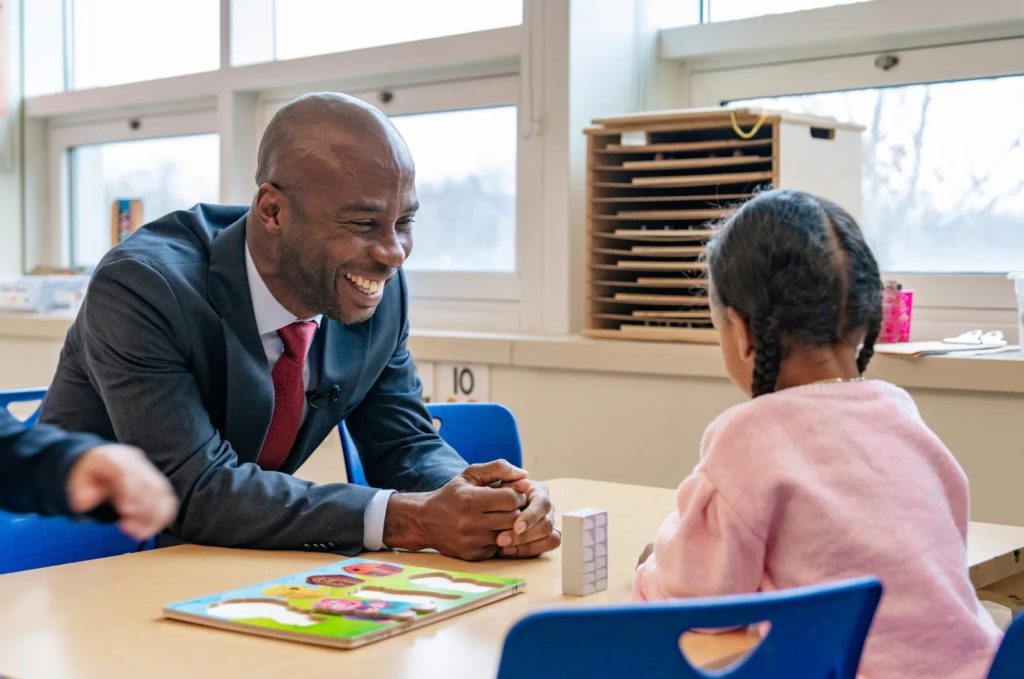
In his first 100 days, Mayor Zohran Mamdani has moved swiftly to reshape the city’s educational landscape, signaling a sharp departure from Mayor Adams. While his campaign primarily focused on affordability and reforms to housing and transportation, Mamdani’s appointment of Kamar Samuels as Schools Chancellor indicates Mamdani’s “cradle-to-college” vision that prioritizes equity over traditional metrics of exclusivity. By appointing Samuels to lead the nation’s largest public school district and securing a landmark childcare deal with the state in the same week, Mamdani is signaling a swift reversal of the previous administration’s expansion of selective programs and not securing consistent funding for others.
Born in Jamaica, Samuels moved to New York City at 16. He was drawn to education while he was studying at Baruch College and served as a tutor to disabled students. Samuels started his career in education in 2001 as an elementary school teacher in the Bronx, eventually rising through the ranks and serving as school superintendent in Brooklyn’s District 13, and Manhattan’s District 3 .
Samuels, who succeeds Melissa Aviles-Ramos, represents the ideological engine of the “new era” Mamdani has been touting. An alumnus of the NYC Teaching Fellows who began his career in the Bronx, Samuels is known for his skepticism toward “Gifted and Talented” (G&T) pipelines, that he argues exacerbate racial segregation. During his campaign, Mamdani spoke about his intentions to scale back the G&T program that starts for kindergarteners, with the concern that starting G&T so early for students decreases equity amongst students and shuts students who are not allowed into the program that early out of educational rigor and opportunities as they get older.
Mamdani, a Bronx Science High School graduate, has tasked Samuels with scaling back kindergarten-level G&T programs citywide. This strategy is modeled on Samuels’ tenure as Superintendent of Brooklyn’s District 13, where he phased out traditional test-based gifted tracks, implemented the International Baccalaureate (IB) framework across neighborhood schools to reduce segregation of opportunities for rigorous education across the district, and managed sensitive school mergers to balance enrollment and diversity.
“In both of those districts, he led really ambitious and well-executed work around increasing diversity in schools and leading community conversations,” Halley Potter, the director of PK-12 education policy, and a senior fellow at the progressive, nonpartisan think tank The Century Foundation, told The Polis Project.
On Thursday, Gov. Kathy Hochul announced that New York State will fund free child care for all two-year-olds and create a road map to expand the program for children under five by the 2028-2029 school year.
Samuels has also expressed the intention to continue building on NYC Reads, a literacy initiative aimed to get reading levels up by mandating a uniform curriculum for early childhood education classes. The nonprofit organization The Advocates for Children of New York congratulated Samuels in a recent statement, alongside a set of policy recommendations that address issues such as accessibility, transportation barriers and building upon NYC Reads.
While Randi Levine, the organization’s policy director, is looking forward to seeing universal child care unfold, she hopes that Mamdani and Samuels will keep current education initiatives afloat in the city budget, and center children who are disabled, English second language speakers, and reside in shelters.
“Too often in initiatives and expansions, children who have the most needs get left behind,” Levine told The Polis Project. “And so we want to make sure that these conversations continue, because child care will not be universal if children with disabilities are turned away. And I say that because right now, we are not yet serving every three and four year old child with a disability.”
The organization, Levine said, has had legal battles with the Department Of Education (DOE), both past and ongoing, with a pressing issue being the outdated school bus service. “The city currently is using school bus contracts that date back to 1979,” Levine said. “What that means is that the Mamdani administration has an opportunity to revamp school bus service because it has not worked for students and families, but to make that happen, they’re going to need to focus.”
Levine remains optimistic in the appointment of Samuels, who voiced intentions to ensure “that every child has the education and support they need to succeed, “during his appointment speech
Potter added: “I remember hearing [about Samuels’ appointment] on New Year’s Eve and…I think it’s a great time to be a student or a parent or anyone who’s invested in the success of New York City schools.”
The United Federation of Teachers, the teachers’ union, expressed similar support for Mamdani and Samuels’ appointment. But, the union also has concerns on several legislative fronts which the new administration and City Council will need to navigate: from pension reform, and the Department of Education’s healthcare plan, to trying to pass a bill to provide support staff in schools— particularly those working with disabled students— a pay increase.
We like bringing the stories that don’t get told to you. For that, we need your support. However small, we would appreciate it.
This is not a paywall.