
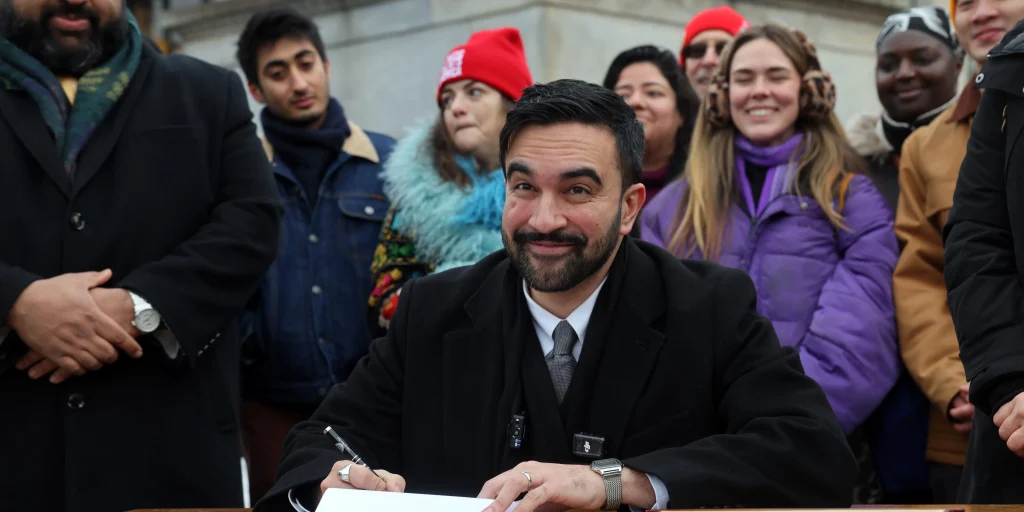
Housing advocates are encouraged to see Mamdani issue three executive orders targeting New York City’s housing affordability crisis.
Right after his historic inauguration ceremony on the steps of New York City Hall, Mayor Zohran Mamdani hit the ground running by rescinding two Adams-era executive orders (EOs) related to Israel, and signing three EOs targeting his key campaign promises of making housing more affordable.
Mamdani notably signed an EO revoking all of former Mayor Adams’ orders signed after September 2024, when the former police captain was indicted on federal corruption charges. The indictment was later dismissed by the Trump administration, but Mamdani said that he thought that was when Adams lost the public’s trust.
“That was a date that marked a moment when many New Yorkers decided politics held nothing for them,” Mamdani said during a briefing, aiming to change that by also later signing an EO encouraging New Yorkers to participate in local government.
Mamdani sent a strong signal to pro-Palestinian members of his base by revoking the executive orders which prevented city agencies from boycotting or divesting from Israel, and included criticism of Israel in the definition of antisemitism.
The government of Israel levied charges of antisemitism against the new mayor of the city with the largest Jewish population outside of Israel. Mamdani, however, did not rescind Adams’ creation of a separate city office to combat antisemitism and plans to keep the office running and funded.
Not all Jewish groups were opposed to the Mayor’s actions. “The Eric Adams Executive Orders [Mamdani] revoked were geared toward silencing New Yorkers who spoke out for Palestine freedom,” wrote the New York arm of the Jewish Voice for Peace, a Jewish anti-zionist group, on Instagram. “One attacked our right to boycott. The other codified a warped definition of antisemitism widely opposed by civil rights groups. Good riddance! As Jewish New Yorkers, we strongly support the revocation of these dangerous [EOs], which do nothing to keep Jews safe. The days of unconditional support for the Israeli government are over!”
Dania Rajendra, who has previously served on the board for Jews for Racial and Economic Justice, told Polis Project: “The executive orders the mayor rescinded – all of them, not just the ones pertaining to antisemitism – are anti-democratic policies, and alongside other progressives, Jews and our organizations have opposed most of them for years. In this, as in all things, the Israeli government does not represent Jewish New Yorkers — this is why, together with our neighbors, New Yorkers elected a mayor who does.”
With his housing executive orders, Mamdani committed to making the Mayor’s Office to Protect Tenants a stronger enforcement body that defends renters’ rights and appointed tenant advocate Cea Weaver to lead it. Weaver is a member of the Democratic Socialists of America party and has a history of organizing for tenant rights, including playing a role in getting the Housing Stability and Tenant Protection Act of 2019 passed in New York state.
He also created two housing task forces: one that aims to review city-owned land for potential housing development, and another to identify bureaucratic and permitting barriers that slow housing construction.
New York City is facing a decades-long housing crisis where demand has outpaced the number of available homes, and rents have skyrocketed. The vacancy rate, which indicates how many homes are on the market, has dropped to 1.4 percent. This is the lowest it has been since 1968. New Yorkers across income brackets are struggling to live within the five boroughs, according to a report from the Community Service Society of New York. Additionally, nearly 160,000 people in the city are currently unhoused.
“Today, on the first day of this new administration, on the day where so many rent payments are due, we will not wait to deliver action,” said Mamdani, during the press conference where he announced his housing executive orders, at a rent-control apartment building in the Flatbush neighborhood of Brooklyn.
Mamdani also directed his chief legal officer, Steve Banks, to intervene in the bankruptcy proceedings of Pinnacle Realty – a large New York landlord owning rent-stabilized residential buildings – to protect tenants who have experienced long-neglected rental situations.
Housing advocates celebrated Mamdani’s decision to address housing immediately after entering office, and took it as an encouraging sign that the Mayor will continue to push for tenant protections and address the city’s housing crisis—, both part of his overall affordability agenda.
“The executive orders are a great start to the administration,” Andrew Fine, chief of staff and policy director at housing advocacy nonprofit Open New York, told Polis Project. “It’s an exciting signal that they were the first policy-oriented executive orders and announcements of the mayoralty, and we’re hopeful that they’re just the start of a lot of big initiatives to get more housing built.”
“The mayor has come in and declared that he’s going to be laser-focused on housing, which is in itself very exciting,” Ellen Davidson, a staff attorney at the Legal Aid Society who focuses on housing policy issues, told Polis Project. “It seems like he is [taking] his promises on the campaign trail to focus on affordability and focus on housing as part of that affordability focus [and] he’s already laying out how he’s going to accomplish that.”
Davidson expressed excitement at Mamdani’s choice to appoint Weaver as the head of the Mayor’s Office to Protect Tenants. She said that she is watching to see what happens next with this office, which was created during the Bill de Blasio administration, but is widely regarded to have been neglected under former Mayor Eric Adams.
“One of the things that we’re going to have to see is that the office is going to need to be staffed,” said Davidson.”If the office grows, it’s another sign that the administration is very serious about this office and about protecting tenants.”
The housing executive order was one of several that Mamdani signed on his first day in office, which also included establishing his mayoral cabinet and revoking a series of executive orders issued by Adams after Adams was indicted on federal charges of corruption.
“[Mamdani is] truly bringing new energy to this city,” said Bobbie Sackman, a campaign leader at Jews for Racial and Economic Justice, in an interview with The Polis Project during the inauguration. “We’re leaving – I hope – corruption behind and really working for the people here who can’t afford to live here.”
Also among the Adams-era revoked orders was one that allowed ICE to operate on Rikers Island for “criminal investigations,” as well as orders to ban the city’s horse carriage industry and to create City Hall offices for cryptocurrency and rat mitigation.
We like bringing the stories that don’t get told to you. For that, we need your support. However small, we would appreciate it.
This is not a paywall.